
Beyond Reading Aloud: Advanced English Pronunciation Assessment Question Types
Explore 11 advanced DolphinSOE question types, from Q&A and retelling to free speaking, with scoring differences, duration limits, and API parameters.
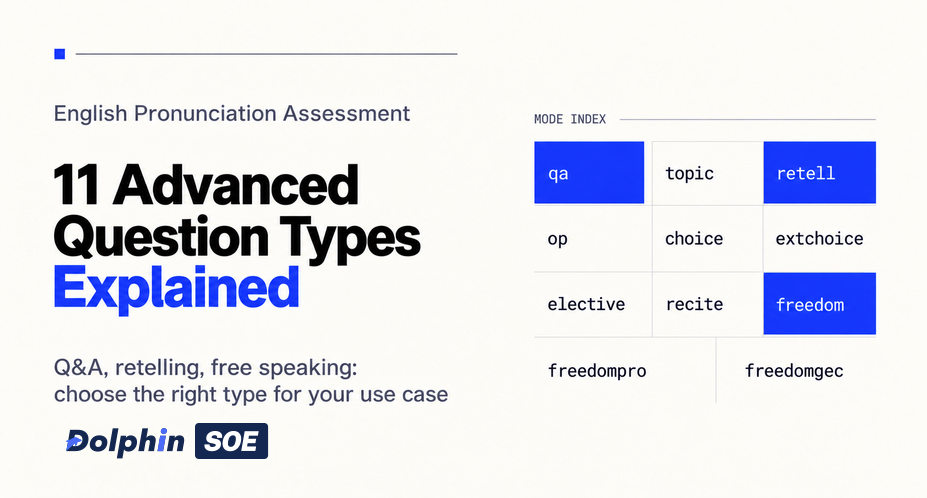
DolphinSOE (Smart Oral Evaluation) supports basic question types for words, sentences, and passages, assessing several aspects of pronunciation when learners read aloud. Speaking ability, however, also involves organizing ideas around a topic, retelling material, and having open conversations with an AI speaking partner. In these situations, learners have no fixed answer to read from. This is where advanced English question types come in.
 Reading a supplied text in basic question types compared with expressing ideas independently in advanced question types
How advanced question types differ from basic ones
Our guide to basic English Pronunciation Assessment question types explains the reading-aloud formats. The distinction is straightforward: basic question types ask learners to read a reference text; advanced question types ask them to express what they want to say.
Basic question types assess how closely the spoken response matches the reference text, including completeness, pronunciation accuracy, and fluency. Most advanced question types do not use a fixed refText and extend assessment to the quality of the response itself. They tend to require more comprehension and expressive ability, are generally not aimed at children, and do not offer dedicated child models.
Questions and answers (qa): assessing comprehension and pronunciation
The qa question type supports situational questions, role-play, and spoken answers. Responses are partly open-ended: learners can answer in their own words around the expected keywords.
Consider this exercise:
Read the following passage:
Surtsey was born in 1963. Scientists saw the birth of this island. It began in the morning. A fishing boat was near Iceland. The boat moved under the captain's feet. He noticed a strange smell. He saw some black smoke. A volcano was breaking out.
Answer the question: What is Surtsey?
Reference answers:
It's an island.
It's an island near Iceland.
It's an island not far from Iceland.
Someone who understands the passage will recognize Surtsey as an island. The opening sentence creates a possible trap: because “Somebody was born in ...” usually refers to a person, a learner might mistake Surtsey for someone's name. Alongside reference answers, the exercise can specify two groups of words:
keyword: correct keywords that earn credit when matched. Here, useisland.distractorKeyword: distractor keywords that reduce the score when matched. Here, usescientistandcaptain. An answer such as “It's the name of a scientist” would match a distractor.
The complete question configuration is:
{
  "mode": "qa",
  "answer": [
    { "text": "It's an island." },
    { "text": "It's an island near Iceland." },
    { "text": "It's an island not far from Iceland." }
  ],
  "keyword": [
    { "text": "island" }
  ],
  "distractorKeyword": [
    { "text": "scientist|captain" }
  ]
}
The system assesses whether the response is correct and also scores its pronunciation. One exercise can therefore assess both comprehension and pronunciation accuracy.
Scores include overall, fluency, accuracy, and integrity. Their meanings are explained in How the Pronunciation Assessment API Works.
Picture and topic descriptions (topic) and oral presentations (op)
These question types support similar activities but handle key points differently.
topic asks learners to speak from a text or a set of pictures. You can supply key points through point, but matching them is counted without affecting the score. The returned hitPoint can show learners which points they covered; scoring still considers overall pronunciation and how well the response matches the expected answer.
op, short for oral presentation, also accepts point. In this question type, the number of matched points affects the overall score.
| Comparison | topic | op |
|---|---|---|
| Do key points affect the overall score? | No; matches are counted only | Yes; pointWeight defaults to 0.7 |
| Returns hitPoint | Yes | Yes |
| Typical use | Picture descriptions and simple descriptions | Topic descriptions, oral presentations, and IELTS Speaking Part 2 practice |
Language-learning teams can use these question types for practice in organizing a response around a topic. The main choice is whether covering the specified points should contribute to the score.
Retelling and recitation (retell / recite)
Both question types ask learners to reproduce material they have heard or read, but the emphasis differs.
retell presents a text or an audio recording and asks the learner to retell it afterward. It assesses pronunciation alongside understanding of the story and coverage of its key points. Like topic, it supports point to count matches without including them in the overall score.
recite is the only advanced question type with a fixed reference text, refText. It resembles the basic question types, but supports recordings up to 600 seconds and emphasizes completeness and fluency when reciting from memory.
Choice, extended choice, and elective reading
Spoken exercises can combine comprehension, choosing an answer, and pronunciation.
choiceawards credit when the learner reads the correct option: understand the question, then say the right answer.extchoiceadds keywords and distractor keywords tochoice. It suits exercises where learners choose an answer and expand it into a fuller response, such as a complete sentence.electivesupplies several sentences and lets the learner read one. The system assesses the best-matching sentence and returns its index.
Use choice when the goal is to check comprehension and answer selection. Use extchoice when learners should elaborate beyond the option. For a lower-pressure exercise such as “Choose the sentence you feel most comfortable reading,” use elective.
Free speaking, open-ended Q&A, and grammar correction
Some speaking tasks, such as a speech on an assigned topic, have no single correct answer. Three question types cover these situations:
freedom: unrestricted speech with no reference text or prescribed content range. Assessment focuses on pronunciation accuracy and fluency.freedompro: comprehensive assessment without a reference text. Supply a topic throughquestionPromptto assessrelevancy, or how well the response addresses that topic.freedomgec: grammar correction. The returnedgrammarobject includescorrectedfor the corrected text,explainfor an explanation, andtypeto indicate whether an error is present.
These question types support different layers of AI speaking practice: getting learners to speak with freedom, helping them improve grammar with freedomgec, and assessing how well they stay on topic with freedompro.
Choosing among the 11 advanced question types
| Question type | Code | Maximum duration | Reference answer required | Content matching | Typical use |
|---|---|---|---|---|---|
| Questions and answers | qa | 60 seconds | Yes (answer) | Keywords and distractors | Situational Q&A, selecting information from listening, role-play |
| Picture or topic description | topic | 600 seconds | Yes (answer) | Key points counted, not scored | Picture descriptions and spoken compositions |
| Story retelling | retell | 600 seconds | Yes (answer) | Key points counted, not scored | Retelling after listening or reading |
| Oral presentation | op | 600 seconds | Yes (answer) | Key points affect the overall score | Topic descriptions and IELTS Speaking Part 2 practice |
| Choice | choice | 60 seconds | Yes (answer) | Option matching | Reading the selected answer |
| Extended choice | extchoice | 60 seconds | Yes (answer) | Keywords and distractors | Reading an option and expanding the answer |
| Elective reading | elective | 60 seconds | Yes (answer) | Sentence matching | Choosing one of several sentences to read |
| Recitation | recite | 600 seconds | Yes (refText) | Matching and prosody | Reproducing text from memory |
| Free speaking | freedom | 600 seconds | No | Pronunciation and fluency only | Unrestricted speaking |
| Open-ended Q&A | freedompro | 600 seconds | No (questionPrompt can be supplied) | Relevance, grammar, and vocabulary | Open-ended Q&A and speaking practice |
| Grammar correction | freedomgec | 600 seconds | No | Grammar correction | Free speaking with corrections |
Start with two questions. Is the learner reading a supplied text or producing their own response? For reading aloud, begin with the basic question types. For an independently formed response, consider the advanced ones.
Then ask whether the exercise has reference answers or key points. If it does, consider qa, topic, op, or retell. If it does not, consider freedom or freedompro.
In the SDK, use mode to select the question type and supply the parameters that type requires. For example, an Android integration selects freedom with json.put("mode", "freedom"). See Integrate the Pronunciation Assessment Android SDK in 10 Minutes for the integration walkthrough.
Integrating DolphinSOE
DolphinSOE is in stable operation in Japan, handling approximately 100,000 calls per day, with customers including language-learning apps, schools, and extracurricular education providers. Its advanced English question types support these learning scenarios.
Discuss your DolphinSOE API integration
Get free technical consultation on API integration, request a one-month free trial, or discuss a business partnership.
Share Article
Read more
ASR Transcription Accuracy: Four Factors Behind the Gap Between 80% and 98%
Explore how recording equipment, environment, microphone distance, and speaker behavior affect ASR transcription accuracy, plus Hotwords, Speaker Separation, confidence scores, and offline transcription.
Integrate the Pronunciation Assessment Android SDK in 10 Minutes
Run a DolphinSOE Android demo from trial credentials and AAR setup through engine initialization, recording or file assessment, and result callbacks.
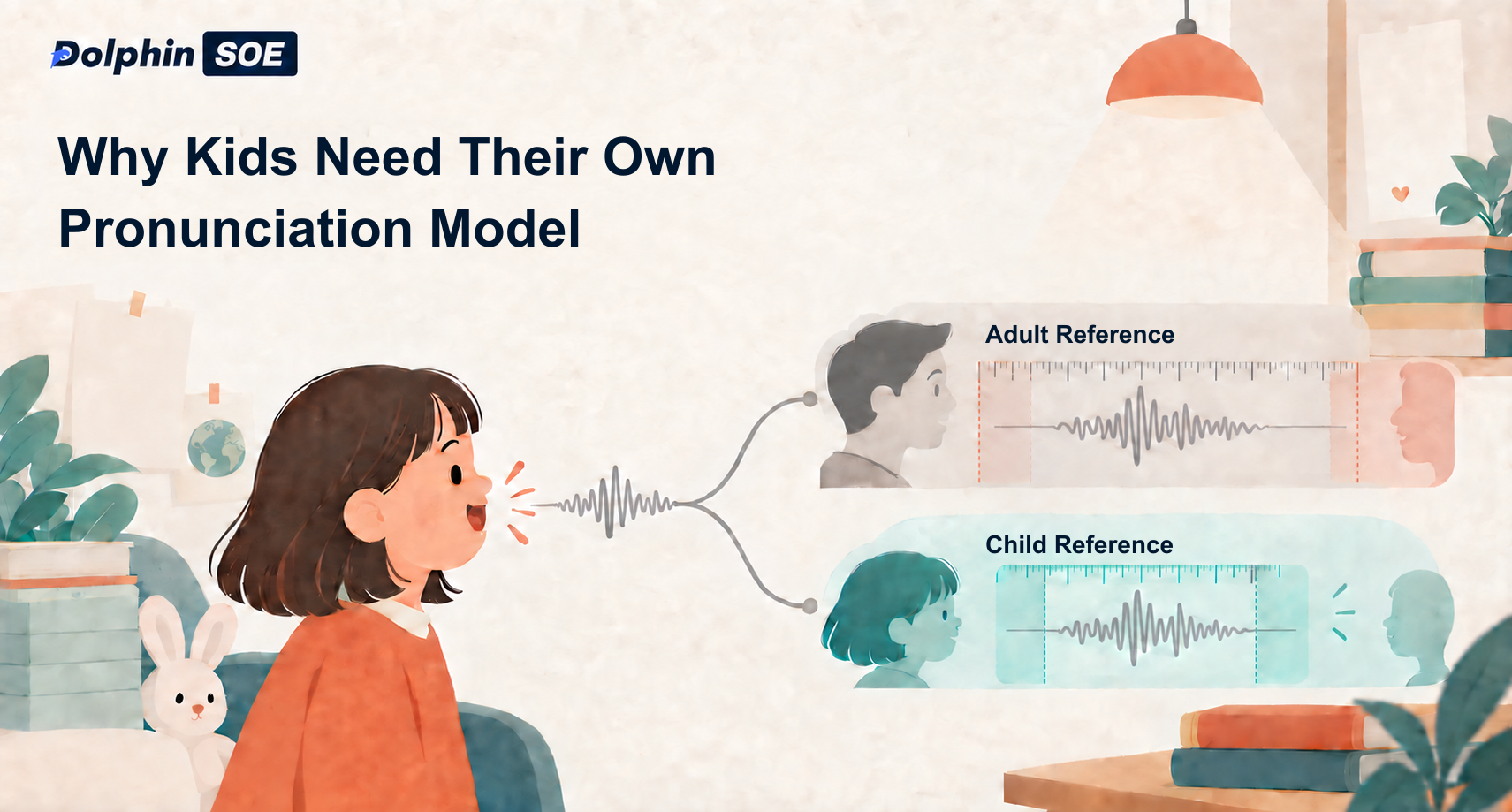
Why Children Need a Dedicated Kids Model for English Pronunciation Assessment
Explore why children need a dedicated English Pronunciation Assessment model, how DolphinSOE Kids models calibrate scores, and how to switch task modes.