
Why Children Need a Dedicated Kids Model for English Pronunciation Assessment
Explore why children need a dedicated English Pronunciation Assessment model, how DolphinSOE Kids models calibrate scores, and how to switch task modes.
Ask a seven-year-old to shoot at a regulation basketball hoop 3.05 meters high, and they may miss. That does not necessarily mean they cannot shoot. The hoop is set for adults. Lowering it to an appropriate height helps reveal the child's ability and progress.
 A child and a basketball beneath a tall basketball hoop.
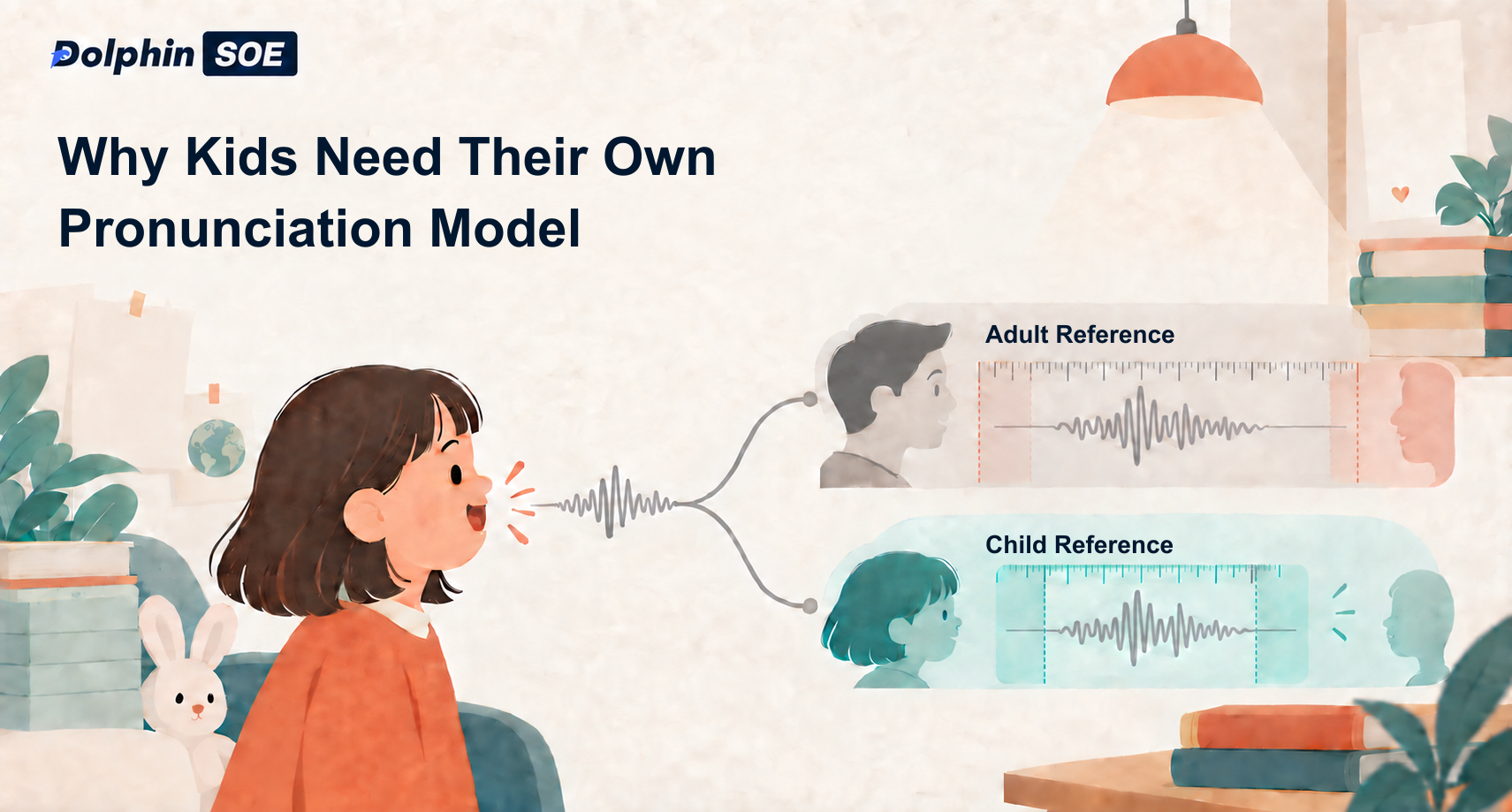
Children's English Pronunciation Assessment faces a similar problem. Most pronunciation assessment engines use acoustic models trained on large amounts of adult speech. Scores from those models can be unreliable for children. But is adapting assessment as simple as lowering the hoop—that is, relaxing the scoring standard? There is more to it.
Our earlier article, From Phonemes to Paragraphs: Understanding the Basic English Pronunciation Assessment Question Types, highlighted a key selection question: are your users adults or children? Here, we examine what a child-specific model actually changes.
What makes children's speech different?
Children are not simply adults whose English pronunciation needs work. Their fundamental frequency, formants, speaking rate, and pronunciation stability differ systematically from those of adults. Their speech features follow a different physical distribution.
| Dimension | Characteristics of children's speech | Impact on a general-purpose model |
|---|---|---|
| Fundamental frequency F0 | Typically 250–400 Hz in school-age children, compared with about 120 Hz in adult men and 200 Hz in adult women [1] | Lower frame-level posterior probabilities across the acoustic model |
| Vocal tract length | A shorter vocal tract shifts formant frequencies upward, approximately in proportion to vocal tract length [1] | A shifted vowel space and biased vowel recognition |
| Speech organs | Still developing; sounds such as /r/↔/w/, /θ/↔/s/, and /l/↔/r/ can be unstable [2] | Pronunciations may be labeled replace |
| Speech rhythm | More pauses, prolonged sounds, weaker breath support, variable volume, and slower speech than adults [3] | Deductions in fluency / integrity |
 First and third formant distributions for vowels at different tongue positions across age groups [1].
The chart shows clear age-related differences in formant distributions for the same vowels. A general-purpose model has learned the adult ranges of these parameters. When the input shifts as a whole, confidence in whether a phoneme was pronounced correctly tends to fall. This acoustic mismatch is a fundamental reason Speech Recognition accuracy has historically been lower for children than for adults.
Where general-purpose models go wrong
These differences can cause several problems when a general-purpose model assesses children's pronunciation.
Systematically lower scores. Acoustic mismatch reduces phoneme posterior probabilities and, in turn, accuracy. The problem is that this reduction does not reflect the child's actual pronunciation ability. Even sustained practice may not translate into a higher score.
False pronunciation errors. Developmental pronunciation differences can be labeled replace. An app may highlight a word as incorrect even when the child has read it correctly. Repeated feedback of this kind can undermine confidence.
Unfair fluency penalties. Measuring children against adult speaking rates can keep fluency scores low. Yet hesitation is a normal part of learning, and fluency is a dimension where children especially need room to develop.
The problem is therefore inaccurate scoring, rather than merely a strict standard. Instead of measuring children's pronunciation ability, the model measures how far their speech is from adult speech.
For products designed for children, the consequences can form a self-reinforcing cycle:
 A cycle of low scores, discouragement, less practice, and slower skill development.
Repeated over time, this cycle can lead users to leave. For a word-level task, the following comparison illustrates typical differences when the same child's recording is assessed by the two models:
| Dimension | word (general-purpose) | word_kids (children) | Reason for the difference |
|---|---|---|---|
| overall | Around 62 | Around 85 | Different acoustic models and scoring curves |
| accuracy | Noticeably low | Returns to a reasonable range | Calibration of phoneme posterior probabilities |
| Word-level type | More likely to be replace | Usually normal | Developmental differences are no longer treated as mispronunciations |
| Phoneme-level feedback | Available | Available | The level of detail is unchanged |
What is the Kids model?
The Kids model combines a dedicated acoustic model tuned on children's speech with a scoring strategy calibrated to children's pronunciation distributions.
It supports three task codes, each corresponding to a general-purpose task:
| Kids task | General-purpose equivalent | Maximum duration | Maximum file size |
|---|---|---|---|
| word_kids | word | 20 seconds | 1 MB |
| sentence_kids | sentence | 90 seconds | 1.5 MB |
| chapter_kids | chapter | 300 seconds | 10 MB |
Apart from the model, task limits, reference-text limits, assessment dimensions, and response structures remain the same as in the general-purpose versions.
More precisely, the Kids model changes the scoring reference: from adult reference pronunciation to the pronunciation distribution of children of a similar age. It does more than raise every score. It puts scores on a fairer basis, supporting comparisons between children and tracking an individual child's progress over time.
To switch from word to word_kids, change a single request parameter: mode.
How the engine adapts to children
If you have read How a Pronunciation Assessment API Works, think of this as a child-specific branch of the same pipeline.
Acoustic model. The underlying dual-head LSTM architecture remains unchanged. Multiple LSTM layers process fbank features, followed by separate text and phoneme output branches. One forward pass produces both text and phoneme alignment. The difference is the training data: the Kids model is trained or adapted using children's read speech across ages, accents, and recording devices. This determines whether phoneme posterior probabilities remain usable for children's recordings.
Scoring calibration. After alignment, scoring curves are recalibrated to the distribution of children's pronunciation, correcting the systematic downward bias. It is like moving a ruler's zero point to the right position.
Data protection in children's learning products
Data protection is another essential consideration in products used by children, whose privacy requires particular care.
DolphinSOE holds multiple information security credentials, including ISO 27001 certification for its ISMS (Information Security Management System), and has obtained a SOC 2 Type II report. Data is encrypted in transit over HTTPS/WSS, and cloud data is stored in a Tokyo data center, remaining in Japan.
Data collection follows the minimum-necessary principle. The SDK does not collect personally identifying information; only audio and assessment text are sent to the engine. By default, the engine does not retain audio. When users need to download recordings, a parameter can enable temporary storage for 30 days, after which the recordings are automatically deleted. Data is neither sold nor rented to third parties.
DolphinSOE operates in the Japanese market at approximately 100,000 calls per day. Its customers include language-learning apps, schools, and after-school education providers. Its capabilities have been tested through ongoing use in high-concurrency teaching scenarios, with adoption by a leading education customer.
Compare both models using the same recording
If you are building a product for children, start by analyzing and comparing your current assessment results. Take a real recording of a child and run it through both the general-purpose model and the Kids model to compare the scores. The scoring dimensions with the largest gaps are often the ones where the general-purpose model has been consistently misjudging the child's speech. When a general-purpose acoustic model trained on adult speech scores children's speech, it treats developmental characteristics as pronunciation errors, pushing scores down across the board. The Kids model changes the scoring reference from “adult standards” back to “the distribution of children's pronunciation.”
References
[1] Vorperian, H. K., & Kent, R. D. (2007). Vowel acoustic space development in children: A synthesis of acoustic and anatomic data. Journal of Speech, Language, and Hearing Research, 50(6), 1510–1545.
[2] Preston, J. L., & Lee, S. (2025). The articulatory basis of phonological error patterns in childhood speech sound disorders. Frontiers in Human Neuroscience, 19, 1635096.
[3] Logan, K. J., Byrd, C. T., Mazzocchi, E. M., & Gillam, R. B. (2011). Speaking rate characteristics of elementary-school-aged children who do and do not stutter. Journal of Communication Disorders, 44(1), 130–147.
Share Article
Read more

Nearly All 26,000 Patient Visit Records Contained Fabricated Content: The Structural Risks of Whisper Hallucinations and Business Countermeasures
Why does Whisper fabricate entire sentences during silence? Drawing on the AP investigation and Cornell University research, this article explains hallucinations in LLM decoders, their cost in four business settings, why post-processing cannot solve them, and a practical silence-testing checklist.
From Phonemes to Paragraphs: Understanding the Basic English Pronunciation Assessment Question Types
How should you choose among DolphinSOE phoneme, word, sentence, chapter, and correction question types? Compare their granularity, limits, scoring dimensions, and best use cases.
How a Pronunciation Assessment API Works: From Audio to Multi-Dimensional Scores
What happens between a learner’s audio and a multi-dimensional pronunciation score? This article breaks down the full pipeline of the DolphinSOE pronunciation assessment API—from capture and alignment to scoring—and walks through a real response.