
OpenAI Whisper API vs DolphinVoice API: Enterprise Speech Recognition Cost and Capabilities Compared
Compare OpenAI Whisper API and DolphinVoice API across architecture, real-time and offline API pricing, all-inclusive TCO, Hotwords, Speaker Diarization, text post-processing, and production-scale validation.
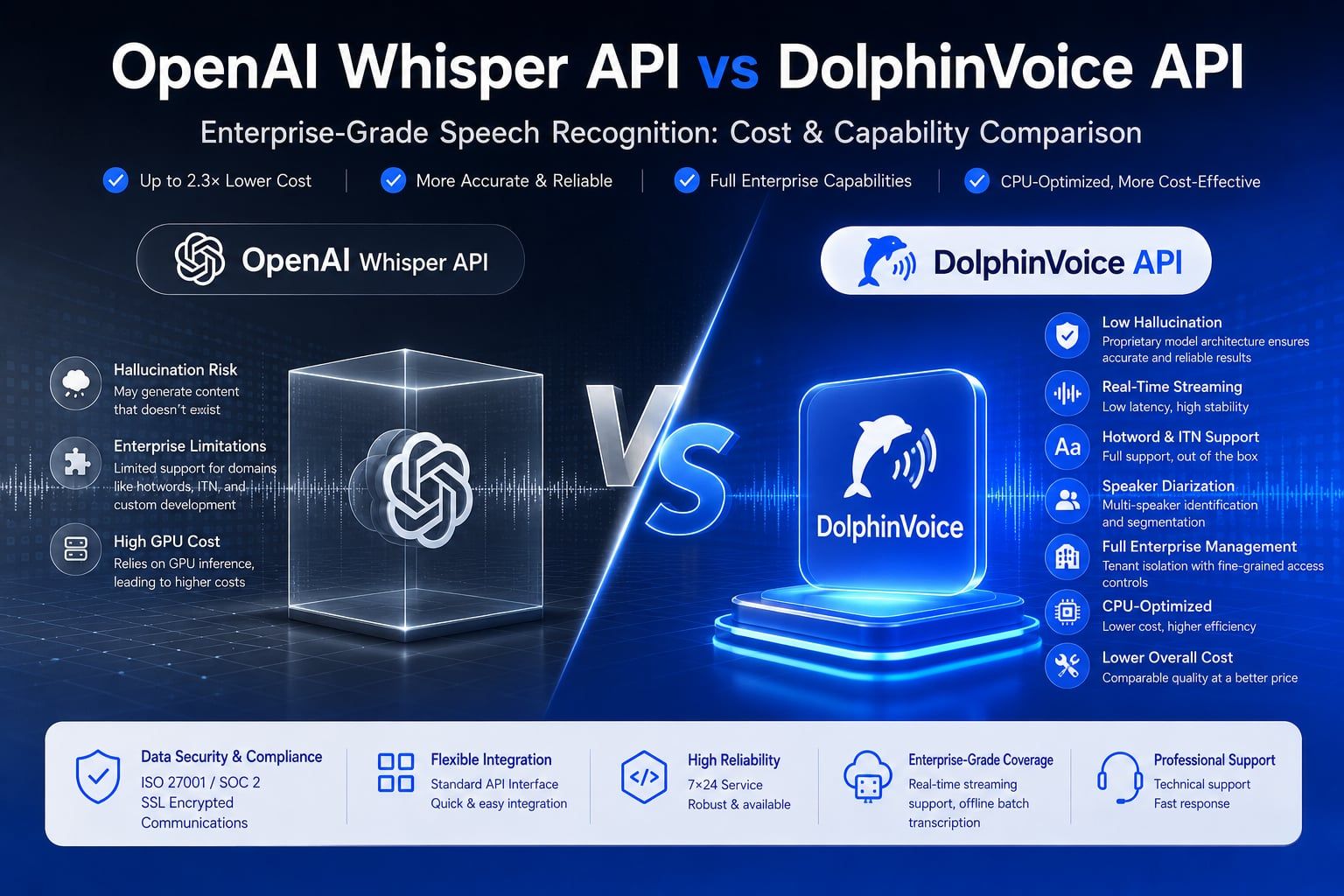
Once speech recognition moves from choosing a model to choosing a platform, WER alone no longer determines the production experience—Accuracy × Latency × Concurrency × Cost × Stability does. And on real-time streaming API pricing alone, OpenAI costs 2.3 times as much as DolphinVoice.
Introduction: Why compare the OpenAI API with the DolphinVoice API?
Real-time speech recognition is becoming core infrastructure for contact center quality management, meeting transcription, live captioning, and Voice Agents.
When a team needs to turn speech into text, the OpenAI Whisper API (and the gpt-4o-transcribe series) is often the default choice—after all, OpenAI's brand and Whisper's open-source ecosystem are deeply embedded in the industry. For many developers evaluating OpenAI alternatives, the core question is really this: both are cloud APIs, so what actually separates OpenAI's speech recognition API from an Enterprise-grade Speech Recognition SaaS?
Once speech recognition enters production—hundreds, thousands, or tens of thousands of hours of commercial calls per day—the challenges an enterprise faces go far beyond recognition accuracy:
- Real-time performance: Can the API return text instantly during a call? How is real-time streaming API priced?
- Enterprise capabilities: Are Hotwords, Speaker Diarization, ITN, punctuation, and Filler Word Filtering available out of the box?
- API pricing: At thousands of hours of speech per day, what will API fees cost?
- Data reliability: Will results fabricate content that was never spoken in the audio?
- Multi-tenant management: How are traffic and quotas isolated between customers?
- System stability: Can it run 24/7 without interruption?
The DolphinVoice API provides Enterprise-grade Speech Recognition as a SaaS service. As an ASR SaaS product, its core technical choice is not to chase ever-larger models, but to redesign the inference architecture for real production environments:
Deliver the lowest possible API pricing while maintaining recognition quality and real-time performance—¥72 per hour for the real-time streaming API, versus ¥163.2 per hour for OpenAI's real-time streaming API (gpt-realtime-whisper).
What is Speech Recognition SaaS? Speech Recognition SaaS is a business model that delivers speech-to-text capability as a cloud service. Customers gain speech recognition through API calls—no GPU hardware to buy, no models to deploy, no operations team to staff. Compared with self-hosting open-source models such as Whisper, a Speech Recognition SaaS bundles infrastructure, engineering, feature integration, security, and compliance into a Usage-based Billing service, so customers pay only for what they actually use. Try real-time recognition and offline transcription yourself in the Playground, or sign up to start API integration right away.
This article compares the OpenAI speech recognition API and the DolphinVoice API systematically across three dimensions: technical architecture, API pricing, and enterprise capabilities.
TL;DR: Key takeaways
Pricing: OpenAI's real-time streaming API (gpt-realtime-whisper) is priced at ¥163.2 per hour—2.3× DolphinVoice's real-time API (¥72 per hour, all-inclusive). For batch transcription, OpenAI gpt-4o-transcribe-diarize costs ¥57.6 per hour, while DolphinVoice offline costs just ¥36 per hour—cheaper, with every enterprise capability included.
All-inclusive TCO: At 300 hours of speech per day (about 100 seats), OpenAI's real-time API at ¥1,468,800 per month plus ¥1,950,000 in hidden costs to fill enterprise gaps totals ¥3,418,800 per month, while the DolphinVoice API's all-inclusive price is ¥648,000 per month. DolphinVoice saves 81.0%, or ¥99,748,800 over three years.
Technology: DolphinVoice uses an End-to-End Transformer architecture with CPU inference and natively supports Streaming, Zero Hallucination, Hotwords, and Speaker Diarization. OpenAI's Whisper series is built on large-model architecture; its real-time streaming API carries hallucination risk, and enterprise capabilities such as Hotwords, ITN, and multi-tenancy are unavailable.
One-line advice: If your business needs real-time streaming recognition plus enterprise capabilities (Hotwords / Speaker Diarization / ITN / multi-tenancy), the DolphinVoice API wins over the OpenAI speech recognition API on both price and capability.
Part 1: Architecture comparison — non-large-model vs large model
1.1 An End-to-End Transformer built for ASR
The Transformer has become the mainstream technical route in speech recognition. DolphinVoice uses an End-to-End Transformer architecture optimized for ASR tasks, devoting as much compute as possible to recognizing speech itself rather than general-purpose text generation.
A typical speech recognition pipeline:
Audio → Feature Extraction → Encoder → Acoustic Representation → Decoder → TextDolphinVoice's architectural goal is explicit:
Put the model's computing power to work on the precise mapping from speech signal to text, not on open-ended text generation from linguistic context.
This is a fundamental design difference from OpenAI's model architecture. OpenAI's Whisper (whisper-1) uses an Encoder-Decoder architecture whose Decoder has strong text-generation ability—an advantage for multilingual coverage, but one that also introduces hallucination risk (see Section 1.2). gpt-4o-transcribe, launched by OpenAI in 2025, reduces the hallucination rate (about 90% fewer, per OpenAI's own claim), but it remains a large-model architecture and does not eliminate hallucination at the root.
| Architecture dimension | DolphinVoice | OpenAI Whisper / gpt-4o-transcribe |
|---|---|---|
| Model architecture | End-to-End Transformer | Encoder-Decoder (whisper-1) / multimodal large model (gpt-4o-transcribe) |
| Design goal | Precise speech-to-text mapping | Transcription + language generation |
| Hallucination risk | Zero (non-large-model architecture) | Present (documented for whisper-1; gpt-4o-transcribe reduces it by about 90% but does not eliminate it) |
| Inference hardware | CPU | GPU |
 Architecture comparison between DolphinVoice and OpenAI Whisper and gpt-4o-transcribe
1.2 Why DolphinVoice does not hallucinate — a design choice of the non-large-model architecture
This is the most fundamental difference between DolphinVoice and ASR systems built on large models.
The training objective of general-purpose generative models (including OpenAI's whisper-1 and gpt-4o-transcribe) includes generating plausible text from context. The objective of a speech recognition system should be:
Reproduce as accurately as possible whatever the user actually said.
OpenAI states this explicitly in the official Whisper documentation:
"The predictions may include texts that are not actually spoken in the audio input (i.e. hallucination). We hypothesize that this happens because, given their general knowledge of language, the models combine trying to predict the next word in audio with trying to transcribe the audio itself."
When OpenAI launched gpt-4o-transcribe in 2025, it claimed about 90% fewer hallucinations—which still leaves roughly 10% residual risk. For call centers, medical records, and legal archives, the difference between "90% reduced" and "zero hallucination" is a difference in kind, not degree.
Academic research shows how serious Whisper's hallucination problem is:
| Finding | Source |
|---|---|
| About 1% of transcripts contain entirely fabricated phrases or sentences | Koenecke et al., 2024 (ACM FAccT) — "Whispered Trust: Audit & Improve Speech-to-Text Systems" |
| 38% of hallucinated output contains harmful content (fabricated associations, false attribution, violence) | Koenecke et al., 2024 |
| Hallucination rates on stuttered speech: 14% on v2, down to 6.9% on v3 (not eliminated) | Sridhar & Wu, 2025 |
| Long silences, background noise, and non-speech audio can all trigger hallucinations | Atwany et al., 2025 |
| Common hallucinated phrases include "Thank you for watching" and "Subscribe to the channel" | Sourced from YouTube auto-caption training data |
For call centers, medical records, and legal archives, a fabricated passage is far more destructive than a spelling error. It can lead to:
- Erroneous records in compliance reviews
- False customer information in CRM systems
- Misjudgments in quality inspection
- Wrong evidence in legal disputes
DolphinVoice's non-large-model architecture eliminates hallucination at the design level. DolphinVoice's model focuses on the precise mapping from speech signal to text; it has no mechanism for generating text from language distributions, so it cannot produce content that is absent from the audio.
What is zero-hallucination ASR? Zero-Hallucination ASR is a speech recognition system that generates no content beyond what is actually in the audio during transcription. This property comes from a non-large-model architecture—the model performs only a deterministic mapping from speech signal to text, rather than generating text from probability distributions over language, which removes hallucination risk at the root. For call centers, medical records, legal archives, and other scenarios where content fidelity is non-negotiable, zero-hallucination ASR is a bottom-line capability.
For enterprise speech data—product model numbers, phone numbers, order IDs, amounts, professional terminology—these do not need the model to "generate a plausible answer"; they need "recognize exactly what was said."
1.3 Why DolphinVoice's API pricing is lower — the cost advantage of CPU inference
DolphinVoice is deeply optimized for CPU inference. In a standard server environment:
| Configuration | DolphinVoice inference environment |
|---|---|
| Inference hardware | CPU (no GPU required) |
| First-response latency | About 1 second |
| Offline processing speed | Up to about 58 seconds per hour of audio in some scenarios (including Speaker Diarization) |
A CPU inference architecture means DolphinVoice needs no expensive GPU instances—infrastructure costs fall far below GPU-based setups, and that cost advantage flows directly into API pricing:
| API | Inference architecture | Real-time streaming API price | Batch transcription API price |
|---|---|---|---|
| DolphinVoice | CPU | ¥72/hour (all-inclusive) | ¥36/hour (all-inclusive) |
| OpenAI gpt-realtime-whisper | GPU | ¥163.2/hour | — |
| OpenAI gpt-4o-transcribe-diarize | GPU | — | ¥57.6/hour |
OpenAI pricing sources: OpenAI's official pricing page and third-party pricing databases (costgoat.com, aiwiki.ai), verified August 2026. Exchange rate: 1 USD ≈ 160 JPY. gpt-realtime-whisper: $0.017/min = $1.02/hour ≈ ¥163.2/hour; gpt-4o-transcribe: $0.006/min = $0.36/hour ≈ ¥57.6/hour. DolphinVoice pricing is based on the official dolphinvoice.ai price list: ¥72/hour for real-time (standard) and ¥36/hour for offline (standard), with tiered pricing—the more you use, the lower the unit price.
For customers choosing the DolphinVoice API, CPU inference means:
- Lower API costs—real-time streaming API pricing is just 44% of OpenAI's (¥72 vs ¥163.2 per hour)
- More reliable service—CPU capacity is plentiful and scales quickly, unaffected by GPU supply-chain volatility
- No operations burden—no GPU drivers, CUDA versions, VRAM OOM, or node health checks to manage
- Pay-as-you-go—pay only for actual usage: ¥72/hour real-time, ¥36/hour offline
Part 2: API pricing and true cost comparison
OpenAI and DolphinVoice both offer speech recognition as cloud APIs, but their pricing models and capability scopes differ sharply. The analysis below shows: on real-time streaming API pricing alone, OpenAI costs 2.3 times DolphinVoice—and DolphinVoice's ¥72 per hour already includes every enterprise capability such as Hotwords, Speaker Diarization, ITN, and multi-tenancy, while OpenAI's API requires additional development to match.
How to read this comparison: the DolphinVoice column shows the SaaS API fees a customer actually pays (¥72 per hour of audio, all-inclusive, with every enterprise capability). The OpenAI column shows the API fees a customer pays to call the OpenAI API—only part of the total cost, since development costs for Hotwords, real-time Speaker Diarization, ITN, multi-tenancy, and other enterprise capabilities are not included (see Section 2.5).
We compare across the following dimensions:
API pricing × real-time streaming vs batch × the cost of filling enterprise gaps
2.1 OpenAI speech recognition API pricing
OpenAI currently offers several audio transcription API models at very different price points:
| Model | Per-minute price | Per-hour price (≈JPY) | Capability |
|---|---|---|---|
| gpt-realtime-whisper | $0.017/min | $1.02/hr ≈ ¥163.2/hr | Real-time streaming transcription |
| whisper-1 (legacy) | $0.006/min | $0.36/hr ≈ ¥57.6/hr | Batch transcription, hallucination risk |
| gpt-4o-transcribe | $0.006/min | $0.36/hr ≈ ¥57.6/hr | Batch transcription, hallucinations reduced by about 90% |
| gpt-4o-mini-transcribe | $0.003/min | $0.18/hr ≈ ¥28.8/hr | Low-cost version, slightly lower accuracy |
| gpt-4o-transcribe-diarize | $0.006/min | $0.36/hr ≈ ¥57.6/hr | Batch transcription + Speaker Diarization |
DolphinVoice API pricing:
| Service | Billing unit | Price |
|---|---|---|
| Real-time Speech Recognition | Per audio duration | ¥72/hour (all-inclusive) |
| Offline Speech Recognition | Per audio duration | ¥36/hour (all-inclusive) |
DolphinVoice Real-time Speech Recognition is standard-priced at ¥72 per hour and Offline Speech Recognition at ¥36 per hour—both all-inclusive, covering Streaming, Speaker Diarization, Hotwords, ITN / Smart Punctuation / Filler Word Filtering / LLM Smoothing / sensitive-word handling / Forced Replacement / Word-level Information, multi-tenant management, operations, and security compliance. Pricing is tiered: the more you use, the lower the unit price. See the complete pricing system in the DolphinVoice API pricing guide.
OpenAI pricing sources: OpenAI's official pricing page and third-party pricing databases (costgoat.com, aiwiki.ai, nativeai.agency), verified August 2026. Exchange rate: 1 USD ≈ 160 JPY. OpenAI bills by input audio duration (not speech duration), with a 25 MB file-size limit per request (about 30 minutes of audio); longer audio must be split.
2.2 Real-time streaming API pricing — OpenAI costs 2.3 times DolphinVoice
For real-time scenarios such as call centers, the API must support low-latency streaming output.
| Dimension | OpenAI (gpt-realtime-whisper) | DolphinVoice API |
|---|---|---|
| Per-hour price | ¥163.2 | ¥72 |
| Included capabilities | Bare transcription | All-inclusive (Streaming + Speaker Diarization + Hotwords + ITN + Smart Punctuation + Filler Word Filtering + LLM Smoothing + sensitive-word handling + Forced Replacement + Word-level Information + multi-tenancy + Zero Hallucination) |
| Hallucination risk | Present (Whisper series) | Zero Hallucination |
| Hotwords | ❌ Not supported | ✅ API parameter |
| Real-time Speaker Diarization | ❌ Not supported (batch diarize only) | ✅ Built in |
Key finding: OpenAI's real-time streaming API not only costs 2.3 times DolphinVoice's—it delivers only bare transcription. DolphinVoice's ¥72 per hour already includes every enterprise capability, while OpenAI customers must build them themselves.
2.3 Batch transcription API pricing — DolphinVoice is cheaper and does more
For offline batch transcription, we compare against OpenAI's diarization-enabled gpt-4o-transcribe-diarize—at ¥57.6 per hour it already includes Speaker Diarization (same price as the standard version, no extra fee). Yet DolphinVoice Offline Speech Recognition costs just ¥36 per hour—cheaper, and still with every enterprise capability included:
| Dimension | OpenAI (gpt-4o-transcribe-diarize) | DolphinVoice API |
|---|---|---|
| Per-hour price | ¥57.6 | ¥36 |
| Monthly API cost (9,000h) | ¥518,400 | ¥324,000 |
| Difference | — | DolphinVoice saves ¥194,400/month |
| Speaker Diarization (batch) | ✅ Built in | ✅ Standard |
| Speaker Diarization (real-time) | ❌ Not supported | ✅ Standard |
| Included capabilities | Transcription + batch diarization | All-inclusive |
| Hotwords | ❌ | ✅ |
| ITN | ❌ | ✅ |
| Punctuation | Basic | ✅ Semantic-level |
| Filler Word Filtering | ❌ | ✅ |
| LLM Smoothing | ❌ | ✅ |
| Sensitive-word filtering | ❌ | ✅ |
| Forced Replacement | ❌ | ✅ |
| Word-level Information | ❌ (unavailable on gpt-4o) | ✅ |
| Multi-tenancy | ❌ | ✅ |
| Hallucination risk | Reduced by about 90% (not eliminated) | Zero Hallucination |
| Audio length per request | ≤ 25 MB (about 30 minutes), must split yourself | Up to 6 hours (longer available by arrangement) |
Conclusion: For batch transcription, DolphinVoice is not only cheaper (¥36 vs ¥57.6 per hour, saving ¥194,400 per month) but also adds 7 text post-processing capabilities + Hotwords + multi-tenancy + real-time Speaker Diarization + Zero Hallucination. Additionally, OpenAI caps a request at 25 MB (about 30 minutes of audio); longer recordings must be split, re-requested, and stitched together, adding significant engineering complexity. DolphinVoice processes up to 6 hours of audio in a single request, with longer durations customizable—eliminating the whole development effort of splitting, concurrency management, and result merging.
2.4 Scenario: 300 hours per day (about 100 seats)
Business parameters:
- Daily speech volume: 300 hours
- Operating window: 08:00–20:00 (12 hours/day)
- Average real-time concurrency: 300 ÷ 12 = 25 channels
- Monthly speech volume: 300 × 30 = 9,000 hours
Monthly real-time streaming API cost:
| Option | Unit price | Monthly API cost | Included capabilities |
|---|---|---|---|
| OpenAI (gpt-realtime-whisper) | ¥163.2/hour | ¥1,468,800 | Bare transcription |
| DolphinVoice API | ¥72/hour | ¥648,000 | All-inclusive |
Conclusion: In the real-time streaming scenario, OpenAI's API costs 2.3 times DolphinVoice's (¥1,468,800 vs ¥648,000)—and DolphinVoice's fee already includes every enterprise capability.
2.5 The hidden cost of filling enterprise gaps — beyond API fees
OpenAI's API provides transcription only; the following enterprise capabilities must be built by the customer—while the DolphinVoice API already includes all of them.
Hidden-cost estimate (100 seats / 300h per day, real-time streaming scenario):
| Hidden cost item | What an OpenAI-based stack must do | Monthly estimate (JPY) | DolphinVoice API |
|---|---|---|---|
| Real-time Speaker Diarization | OpenAI offers batch diarize only; real-time requires integrating pyannote.audio | ¥350,000 | Built in, with Customer / Agent role separation |
| Hotwords | No custom vocabulary injection; build your own post-processing correction | ¥200,000 | API parameter, effective immediately |
| Text post-processing pipeline | ITN + punctuation + Filler Word Filtering + LLM smoothing + sensitive words + Forced Replacement + word-level alignment | ¥400,000 | All 7 capabilities built in, toggled via API parameters |
| Multi-tenant platform | API gateway + quotas + metering + key management | ¥750,000 | Tenant-level management console built in |
| Integration operations + on-call | Monitoring, error handling, degradation, 24/7 duty for the API integration layer | ¥250,000 | Fully managed on the platform side |
| Hidden-cost total | ¥1,950,000 | ¥0 (all included) |
Estimated from Japan-market talent costs (including social insurance and benefits). Reference ranges: ML engineers ¥700,000–900,000/month, backend engineers ¥600,000–800,000/month, DevOps ¥500,000–700,000/month, allocated by each module's share of responsibility. As volume grows, the team must scale and hidden costs grow with it. Note: gpt-realtime-whisper already provides real-time streaming, so no additional Streaming engineering is required.
2.6 All-inclusive TCO comparison
OpenAI API + hidden costs vs DolphinVoice API all-inclusive:
| Scale | OpenAI API monthly | Hidden costs | OpenAI total | DolphinVoice (all-inclusive) | DolphinVoice saves |
|---|---|---|---|---|---|
| 300h/day (100 seats) | ¥1,468,800 | ¥1,950,000 | ¥3,418,800 | ¥648,000 | 81.0% |
Annual and 3-year TCO:
| Period | DolphinVoice API (all-inclusive) | OpenAI API + hidden costs | Difference |
|---|---|---|---|
| Monthly | ¥648,000 | ¥3,418,800 | ¥2,770,800 |
| Annual | ¥7,776,000 | ¥41,025,600 | ¥33,249,600 |
| 3-year TCO | ¥23,328,000 | ¥123,076,800 | ¥99,748,800 |
 All-inclusive TCO comparison between OpenAI and DolphinVoice
Conclusion: At 100 seats, choosing the OpenAI real-time API costs ¥123,076,800 over three years, while calling the DolphinVoice API costs ¥23,328,000—choosing OpenAI means spending ¥99,748,800 more over three years. API fees account for 43% of that total; the remaining 57% comes from hidden costs such as real-time Speaker Diarization, Hotwords, text post-processing, multi-tenancy, and operations.
One-line summary: OpenAI's real-time streaming API already costs 2.3 times DolphinVoice's before any extras (¥163.2 vs ¥72 per hour). After adding Hotwords, Speaker Diarization, ITN / Smart Punctuation / Filler Word Filtering / LLM Smoothing / sensitive words / Forced Replacement / Word-level Information, and multi-tenancy, OpenAI's total cost reaches 5.3 times DolphinVoice's. With the DolphinVoice API, one key delivers all of the above—Usage-based Billing, with volume discounts at scale.
Part 3: Enterprise capability comparison
A model determines recognition capability, but only a complete platform determines whether an enterprise can actually use it. Once ASR enters production, customers need far more than Speech → Text—they need a full set of enterprise capabilities. That is the core value of choosing the DolphinVoice API over the OpenAI API: every capability below is built in and ready on day one.
 Enterprise capability matrix comparing OpenAI Whisper API and DolphinVoice API
3.1 Hotwords and specialized vocabulary
Enterprise speech is full of content generic models struggle to recognize reliably: company names, product names, brands, people, professional terminology, product model numbers, and industry vocabulary.
DolphinVoice natively supports Hotwords:
Generic ASR → raw output → "Is your order number D F 3 8 0 2?"

DolphinVoice + Hotwords → vocabulary boost → "Is your order number DF-3802?"
Enterprises can build their own vocabularies so the ASR understands the language of their business.
OpenAI API limitations: Neither the Whisper API nor gpt-4o-transcribe supports custom vocabulary injection. The optional prompt parameter can influence spelling style, but it is not a true Hotwords feature—it cannot guarantee accurate recognition of specific terms or product names. Achieving hotword-like behavior on the OpenAI API means building your own post-processing correction system, adding engineering complexity.
3.2 Speaker Diarization
For multi-party scenarios such as meetings, contact centers, and interviews, Speaker Diarization is a core capability.
[Agent]    Hello, how can I help you today?
[Customer] I have a question about my order.
[Agent]    Sure, could you give me your order number?
DolphinVoice automatically distinguishes speakers and can further separate Customer and Agent roles in call center scenarios. This makes transcripts more readable and provides structured data for downstream contact center QA, CRM integration, AI summaries, compliance reviews, and conversation analytics.
OpenAI API limitations: OpenAI launched gpt-4o-transcribe-diarize at the end of 2025, supporting batch Speaker Diarization (same ¥57.6-per-hour pricing, no extra fee). But the capability is batch-only and does not support real-time streaming. Call centers that need to distinguish agents from customers live during a call must still integrate a separate system such as pyannote.audio.
3.3 Multi-tenant traffic management
For SaaS platforms, ASR is far more than a model API. An enterprise speech recognition platform must solve resource management between customers.
Tenant A ─┐
          │
Tenant B ─┼──→ API Gateway → Traffic Management → ASR Cluster
          │
Tenant C ─┘
DolphinVoice provides complete tenant-level management:
| Capability | Description |
|---|---|
| Usage statistics | Recognition hours and call counts per tenant |
| Concurrency control | Maximum concurrent channels per tenant |
| Traffic limiting | Prevents any single tenant from monopolizing resources |
| Quota management | Monthly / annual quotas |
| API Key management | Independent key per tenant |
| Usage billing | Metered billing on actual usage |
| Resource isolation | Logical isolation between tenants, no mutual impact |
DolphinVoice targets SaaS-grade enterprise production environments—not just an ASR Model.
OpenAI API limitations: OpenAI's API is a generic model-calling interface with no multi-tenant management. Enterprises must build the API gateway, multi-tenant management, metered billing, and every other platform capability themselves—an engineering investment far beyond the API calls themselves. With the DolphinVoice API, all of this is implemented on the platform side; customers only manage their own tenant configuration and API keys. See the developer documentation for API integration details and parameters.
3.4 Intelligent text post-processing
Raw ASR output is rarely ready for business use. On top of recognition results, the DolphinVoice platform includes a complete text post-processing suite so output works out of the box.
What is ITN (Inverse Text Normalization)? ITN is a core speech recognition post-processing step that automatically converts spoken numbers, dates, and amounts into written form (for example, "three point five kilograms" → "3.5kg", "one hundred twenty-three" → "123", "August two thousand twenty-six" → "August 2026"). ITN makes transcripts directly usable for data warehousing, reporting, and structured storage—an indispensable capability for an enterprise speech recognition API.
| Capability | Description | Business value |
|---|---|---|
| ITN (Inverse Text Normalization) | Converts spoken numbers to written form: "three point five kilograms" → "3.5kg", "one hundred twenty-three" → "123" | Transcripts ready for data warehousing and reporting |
| Smart Punctuation | Automatically adds commas, periods, and question marks based on semantics | Improves readability, no manual sentence splitting |
| Filler Word Filtering | Removes meaningless fillers such as "um", "uh", and "like" | Clean transcripts for contact center QA and archiving |
| LLM Smoothing | Uses an LLM to smooth and polish spoken-style recognition results | Fluent text ready for meeting minutes and publishing |
| Sensitive-word filtering | Detects and masks sensitive content by business rules | Meets compliance requirements in regulated industries such as finance and healthcare |
| Forced Replacement | Replaces specific words with target words by preset rules | Unifies brand and product terminology, removes recognition ambiguity |
| Word-level Information | Start/end timestamps and confidence per word | Supports subtitle alignment, audio segment location, QA scoring |
Raw output → ITN → Smart Punctuation → Filler Word Filtering → Sensitive-word detection → Forced Replacement → Final output
                                    ↘ LLM Smoothing (optional)
All post-processing capabilities can be toggled flexibly via API parameters, enabled per business scenario.
OpenAI API limitations: OpenAI's API outputs raw recognized text only (whisper-1 has basic punctuation; gpt-4o-transcribe is slightly better)—no ITN, Filler Word Filtering, LLM Smoothing, sensitive-word handling, or Forced Replacement. Word-level timestamps are supported only by whisper-1 via verbose_json; the gpt-4o series does not support word-level timestamps. Enterprises must build their own text-processing pipeline, with substantial engineering and maintenance costs.
3.5 One platform for real-time and offline
Enterprises usually have both needs at once. As a unified speech-to-text API platform, DolphinVoice brings real-time and offline capabilities into the same service system.
Real-time transcription (WebSocket Streaming):
WebSocket → Streaming ASR → Partial Result → Final ResultSuited for: Call Centers / Voice Agents / live captioning / meetings / online customer service
Offline recognition (Batch Processing):
Audio File → Batch Processing → ASR → Speaker Diarization → Structured TranscriptSuited for: batch transcription / meeting archives / contact center QA / data analysis / historical audio processing
Both real-time and offline features can be tried directly in the Playground. DolphinVoice prices real-time at ¥72 per hour and offline at ¥36 per hour, while OpenAI's real-time API (gpt-realtime-whisper at ¥163.2 per hour) and batch API (gpt-4o-transcribe-diarize at ¥57.6 per hour, including diarization) are both priced higher than DolphinVoice.
Part 4: Validation in real production
The DolphinVoice platform is not a lab product. It runs continuously in real commercial environments, handling tens of thousands of hours of speech every day. This data validates not only the technology but DolphinVoice's stability and reliability as a SaaS service—the API customers connect to is backed by a production system proven at large commercial scale.
Speech recognition volume
15,000 hours / day
Covering call center real-time recognition, meeting transcription, and Voice Agent interaction.
Speech Evaluation volume
100,000 calls / day
Pronunciation quality assessment for language learning and oral testing.
 DolphinVoice production-scale validation data
This real production data validates DolphinVoice's capabilities across the following dimensions:
| Dimension | Result |
|---|---|
| High concurrency | 15,000+ hours of real-time recognition running stably every day |
| CPU inference | All workload runs on CPU servers, no GPU dependency |
| Long-term stability | 24/7 uninterrupted operation |
| SaaS multi-tenancy | Multiple customers share the cluster with traffic isolation |
| Low latency | First-response latency about 1 second |
FAQ
Can the OpenAI API do real-time speech recognition?
Yes, but at a higher price. OpenAI offers gpt-realtime-whisper for real-time streaming transcription at $0.017 per minute (≈¥163.2 per hour). The DolphinVoice API also supports real-time streaming recognition (WebSocket Streaming, first-response latency about 1 second) at ¥72 per hour—just 44% of OpenAI's. OpenAI's real-time API also lacks Hotwords, real-time Speaker Diarization, and other enterprise capabilities that DolphinVoice includes.
Which is cheaper, the OpenAI API or the DolphinVoice API?
It depends on the scenario. For real-time streaming, DolphinVoice (¥72/hour) is 55.9% cheaper than OpenAI (¥163.2/hour). For batch transcription, DolphinVoice (¥36/hour) is 37.5% cheaper than OpenAI's diarization-enabled gpt-4o-transcribe-diarize (¥57.6/hour)—while adding 7 enterprise capabilities including Hotwords, ITN, and multi-tenancy, plus real-time Speaker Diarization and Zero Hallucination. Filling those gaps costs about ¥1,950,000 per month, making the all-inclusive TCO 5.3 times DolphinVoice's.
Does the OpenAI Whisper API hallucinate?
Yes. OpenAI's official Whisper documentation states that predictions may include content not actually spoken in the audio (hallucination). Academic research (Koenecke et al., 2024) found that about 1% of transcripts contain entirely fabricated phrases or sentences. gpt-4o-transcribe, launched in 2025, claims about 90% fewer hallucinations—but roughly 10% residual risk remains. DolphinVoice's non-large-model architecture has no text-generation mechanism and eliminates hallucination at the design level.
What is the difference between the DolphinVoice API and the OpenAI API?
| Dimension | DolphinVoice API | OpenAI API |
|---|---|---|
| Inference architecture | CPU (no GPU required) | GPU |
| Hallucination risk | Zero Hallucination | Present (whisper-1) / reduced by about 90% (gpt-4o-transcribe) |
| Hotwords | API parameter, effective immediately | ❌ Not supported |
| Real-time Speaker Diarization | Built in, with role separation | ❌ Batch only |
| Text post-processing | ITN / Smart Punctuation / Filler Word Filtering / LLM Smoothing / sensitive words / Forced Replacement / Word-level Information—7 capabilities built in | ❌ Raw text only |
| Multi-tenancy | Built-in management console and metered billing | ❌ Build your own |
| Real-time pricing | ¥72/hour (all-inclusive) | ¥163.2/hour (bare transcription) |
| Offline pricing | ¥36/hour (all-inclusive) | ¥57.6/hour (including diarization) |
| Audio length per request | Up to 6 hours (longer by arrangement) | ≤ 25 MB (about 30 minutes), must split |
How should you choose a speech recognition API?
If you need any of the following, go directly with the DolphinVoice API:
- Real-time streaming recognition (low-latency Streaming, at a lower price)
- Zero Hallucination (no fabricated content)
- Enterprise-grade text post-processing: Hotwords, real-time Speaker Diarization, ITN
- Multi-tenant management and metered billing
- Up to 6 hours of audio per request (OpenAI allows only 30 minutes, requiring splitting and stitching)
- One unified API for real-time and offline (¥72/hour real-time, ¥36/hour offline)
- 24/7 stable operation and security compliance
The OpenAI API only suits: scenarios that need batch transcription alone, require no enterprise capabilities, and can accept hallucination risk. Even then, gpt-4o-transcribe lacks word-level timestamps and gpt-4o-mini-transcribe is slightly less accurate.
How much does the DolphinVoice API cost?
DolphinVoice Real-time Speech Recognition is standard-priced at ¥72 per hour of audio (all-inclusive) and Offline Speech Recognition at ¥36 per hour of audio (all-inclusive). Both include Streaming, Speaker Diarization, Hotwords, text post-processing (ITN / Smart Punctuation / Filler Word Filtering / LLM Smoothing / sensitive words / Forced Replacement / Word-level Information), multi-tenant management, operations, and security compliance (AICPA SOC 2 Type I + ISO 27001 + APPI compliance + SSL-encrypted communication). Pricing is tiered: the more you use, the lower the unit price. See the API pricing guide for complete pricing.
Conclusion: Which API should you choose? The answer is simple
For an enterprise choosing a speech recognition API, model accuracy is just one metric. What determines the production experience is:
Accuracy × Latency × Concurrency × Cost × Stability
The OpenAI Whisper API (and the gpt-4o-transcribe series) is an excellent general-purpose speech recognition API. But in enterprise production, its real-time streaming API alone costs 2.3 times DolphinVoice's (¥163.2 vs ¥72 per hour), and enterprise capabilities such as Hotwords, ITN, and multi-tenancy require extra development—after which the total cost is 5.3 times DolphinVoice's.
DolphinVoice API's one-line answer:
One API Key. Real-time at ¥72 per hour, offline at ¥36 per hour. Everything above is already included—Usage-based Billing, same-day activation, tiered pricing so the more you use, the less you pay.
From CPU inference to the zero-hallucination architecture, from native Streaming to offline batch transcription, from Hotwords and Speaker Diarization to text post-processing such as ITN, Smart Punctuation, and Filler Word Filtering, from multi-tenant management to security compliance—DolphinVoice is not an API that leaves you to fill the gaps yourself. It is an Enterprise-grade Speech Recognition SaaS, ready on day one.
Start integrating the DolphinVoice API today—no GPU, no operations, pay-as-you-go, with volume discounts at scale. Sign up to activate the API, see the developer documentation for integration details, or check the API pricing guide for complete pricing.
About DolphinAI
DolphinAI is an AI company focused on speech recognition, speech synthesis, and voice conversation technology, providing enterprises with cost-effective, highly reliable Voice AI SaaS. Learn more at About DolphinAI.
Security and compliance
DolphinAI treats data security and privacy protection as core platform capabilities, and maintains multiple international and Japan-specific compliance certifications:
| Certification | Description |
|---|---|
| AICPA SOC 2 Type I | Service Organization Control report verifying DolphinAI's controls over security, availability, processing integrity, confidentiality, and privacy |
| ISO/IEC 27001 (ISMS) | International information security management system certification, ensuring systematic protection of customer information assets |
| APPI compliance | Compliance with Japan's Act on the Protection of Personal Information, meeting Japanese-market data handling and privacy requirements |
| SSL-encrypted communication | All APIs and the console use SSL/TLS encrypted transport, preventing eavesdropping and tampering in transit |
Commercial traffic
| Service | Daily average volume |
|---|---|
| Speech recognition | 15,000 hours / day |
| Speech Evaluation | 100,000 calls / day |
Core capabilities
Recognition
| Capability | Typical scenarios | Core value |
|---|---|---|
| Real-time Speech Recognition | Call Center / Voice Agent / Live Captioning | First-response latency about 1 second, continuous streaming output |
| Offline Speech Recognition | Batch transcription / data analysis / archiving | ¥36/hour all-inclusive, built for large-scale audio |
| Speaker Diarization | Meetings / contact centers / interviews | Automatic speaker distinction |
| Hotwords | Products / brands / professional terminology | Improves business-vocabulary recognition |
| Speech Evaluation | Language learning / oral testing | 100,000 calls/day proven in production |
Text post-processing
| Capability | Typical scenarios | Core value |
|---|---|---|
| ITN | Numbers / amounts / dates | Spoken numbers converted to written form automatically |
| Smart Punctuation | Transcript archiving / QA reports | Semantic-level automatic punctuation |
| Filler Word Filtering | Contact center QA / meeting minutes | Removes meaningless fillers |
| LLM Smoothing | Meeting minutes / content publishing | LLM-based sentence smoothing and spoken-style correction |
| Sensitive-word filtering | Finance / healthcare / compliance | Automatic detection and masking of sensitive content |
| Forced Replacement | Brand consistency / terminology standards | Rule-based forced replacement of target words |
| Word-level Information | Subtitle alignment / segment location | Per-word timestamps and confidence |
Platform and infrastructure
| Capability | Typical scenarios | Core value |
|---|---|---|
| Multi-tenancy | SaaS / enterprise customers | Traffic, quota, and resource management |
| CPU inference | SaaS infrastructure | No GPU dependency; ¥72/hour real-time, ¥36/hour offline all-inclusive |
| Zero Hallucination | Compliance review / healthcare / legal | Non-large-model architecture, faithful to the audio |
DolphinVoice API
Not just a Speech-to-Text API
but an Enterprise-grade Voice AI SaaS, ready on day one.
No GPU · No operations · Pay-as-you-go · Same-day activation
Real-time and offline transcription, zero-hallucination architecture, Hotwords and Speaker Diarization, text post-processing including ITN / Smart Punctuation / Filler Word Filtering / LLM Smoothing / sensitive words / Forced Replacement / Word-level Information, multi-tenant management, CPU inference—all built in, all callable with one API Key.
Get started with DolphinVoice API
Use real-time and file-based Enterprise-grade Speech Recognition with one API Key.
Share Article
Read more
ASR Transcription Accuracy: Four Factors Behind the Gap Between 80% and 98%
Explore how recording equipment, environment, microphone distance, and speaker behavior affect ASR transcription accuracy, plus Hotwords, Speaker Separation, confidence scores, and offline transcription.
Integrate the Pronunciation Assessment Android SDK in 10 Minutes
Run a DolphinSOE Android demo from trial credentials and AAR setup through engine initialization, recording or file assessment, and result callbacks.
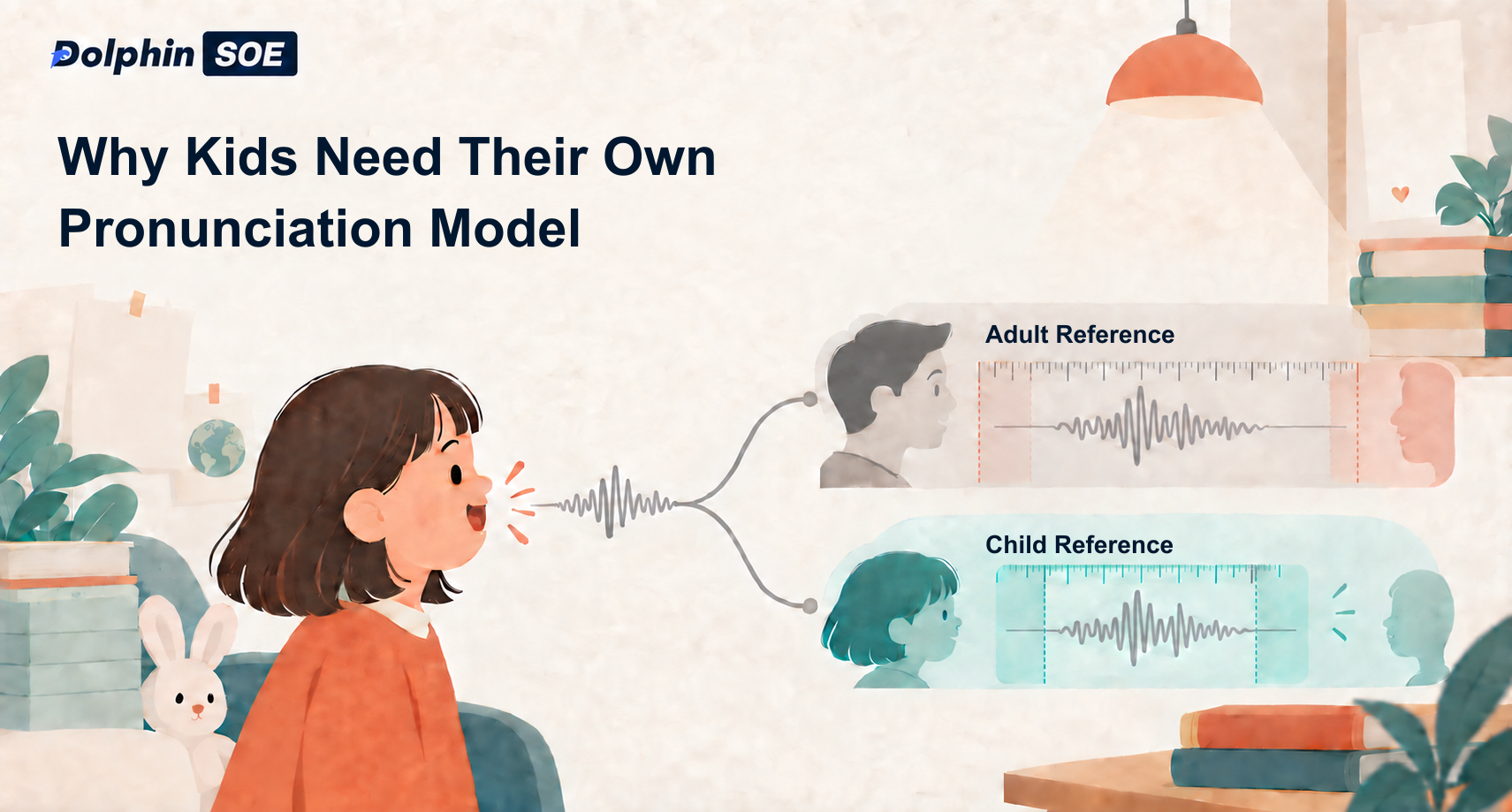
Why Children Need a Dedicated Kids Model for English Pronunciation Assessment
Explore why children need a dedicated English Pronunciation Assessment model, how DolphinSOE Kids models calibrate scores, and how to switch task modes.