
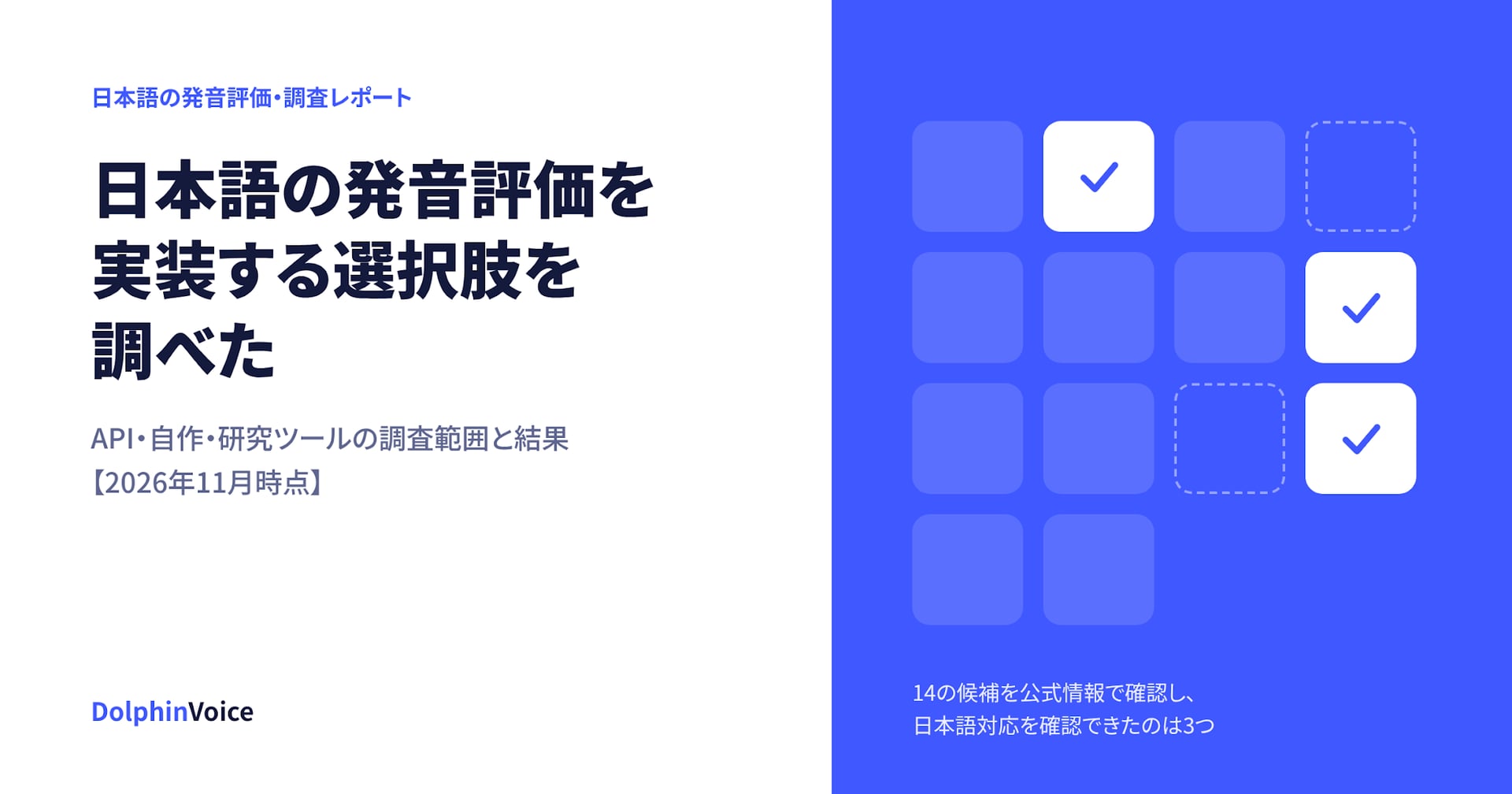
If you want to score spoken Japanese in a learning app or staff training system, the first question is which services can actually return scores for a learner speaking Japanese. On November 11, 2026, we checked the public documentation for 14 candidates. We confirmed three embeddable APIs: Azure AI Speech, SpeechSuper and DolphinSOE. We also examined what it would take to build a scoring system and which research tools can help with teaching materials.
Disclosure. DolphinAI Inc., the company behind DolphinVoice, provides DolphinSOE (Smart Oral Evaluation). We applied the same criteria to our own service as to the others. We did not benchmark scoring accuracy or independently validate vendors’ performance figures.
How we conducted the survey
 Search and verification process: three supported, seven unsupported, two unconfirmed and two outside scope.
| Item | Scope and method |
|---|---|
| Survey date | November 11, 2026. Language support and pricing reflect the official information available on that date. |
| Inclusion | An API or SDK that a service can integrate to score a Japanese learner’s speech (ja-JP) at the phoneme, word or sentence level. For in-house development, we also examined open-source software, models and speech datasets. |
| Search | We searched in English, Japanese and Chinese, using queries such as “pronunciation assessment API Japanese”, “日本語 発音評価 API” and “日语 口语评测”. We checked Azure, Google Cloud, AWS, providers known for English assessment and Chinese speaking-assessment providers individually. |
| Classification | Supported: official documentation or a release mentions Japanese and identifies scoring metrics. Unsupported: Japanese is absent from the official list of supported languages. Unconfirmed: official information was inaccessible or inconclusive. Comparison sites and reviews helped identify candidates only. |
| Exclusions | Standalone speaking tests (including our NihongoScore), apps without external integration, speech recognition APIs without a score, and research tools that restrict commercial use. We discuss research tools separately. |
| Outside the survey | Direct measurements of scoring accuracy and independent verification of performance or usage figures. Other providers may exist outside the search scope. |
Three implementation paths
 Three paths to Japanese pronunciation scoring: an API, an in-house system, or research and teaching tools.
| Approach | Options we found | When it fits |
|---|---|---|
| Integrate an API | Azure AI Speech, SpeechSuper, DolphinSOE | You want to launch in a few months and the scoring method itself is not a competitive differentiator. |
| Build in-house | Phoneme recognition models, Goodness of Pronunciation (GOP) and public speech data | Scoring is central to the product, and you can provide researchers and expert-rated learner recordings. |
| Use research or teaching tools | OJAD, the Japanese accent dictionary, and the open-source Onsei | You need to create teaching materials or check pitch accent. These tools are a poor fit for embedded scoring. |
What the three Japanese APIs return
The vendors define their scores differently. A metric with the same label can represent different measurements.
| Feature | Azure AI Speech | SpeechSuper | DolphinSOE (our service) |
|---|---|---|---|
| Provider | Microsoft | SpeechSuper, Suzhou, China | DolphinAI Inc., Tokyo |
| Integration | API and SDK | API for Japanese. The iOS and Android SDKs support English and Chinese only. | API and SDKs for Android, iOS, H5 and other environments |
| Scoring units | Phoneme, word, whole text | Individual kana, words through sentences, paragraphs | Word (including kana), sentence, passage |
| Main metrics | Accuracy, fluency, completeness with reference text, overall score | Overall score, pronunciation, fluency, completeness, accent (tone), rhythm, speaking rate, final pitch rise or fall | Overall score, accuracy, fluency (pause count and speaking rate), completeness, accent, words per minute |
| Phoneme results | Scores only for ja-JP, without phoneme names | Scores | Scores, hiragana and katakana representations, and the sound actually produced |
| Reading errors | Omissions, insertions, mispronunciations and others | Skipped and repeated material | Omissions, repetitions and out-of-vocabulary items (oov) |
| Accent | Prosody assessment is available for en-US only | Word accent patterns (◎①②…), high/low pitch and an accent score | Dictionary accent pattern, reference pitch by mora and an accent score added in the November 2026 engine update |
| Unscripted speech | Japanese support unconfirmed in this survey | English only | Requires a reference text |
| Custom readings | Not supported | Can annotate readings | Can annotate readings and accent |
| Real-time scoring | Available at streaming speech recognition rates, above the standard rate | Available | Available |
| Published pricing | Same basic pricing as speech recognition | Pay-as-you-go per request, USD 20 monthly minimum | Japanese is included in the fixed monthly Pro plan with an assessment allowance |
Azure AI Speech
Japanese (ja-JP) is one of 33 locales listed for pronunciation assessment. The service returns Accuracy, Fluency, Completeness when a reference is supplied, an overall PronScore and error types. Basic assessment carries no surcharge beyond standard speech recognition pricing.
Best fit. It is a practical choice for teams already using Azure that need accuracy, fluency and completeness. Limitations. Prosody is available only for en-US. For languages other than English and Chinese, phoneme results contain scores without names. To highlight the sound a Japanese learner missed, your app must map the scores back to the text.
SpeechSuper
SpeechSuper offers Japanese word, sentence and paragraph assessment. In addition to overall score, pronunciation, fluency and completeness, it returns accent, rhythm, speaking rate and final pitch movement. Word-level patterns such as ◎①② and high/low pitch information are useful when teaching Japanese pitch accent.
The published rates were USD 0.004 per word request, USD 0.006 per sentence and USD 0.008 per paragraph, with a USD 20 monthly minimum. Best fit. This suits low-volume deployments that need an accent score. Limitations. Japanese requires the API. The SDKs support English and Chinese, and unscripted assessment supports English only. Yen costs vary with the exchange rate.
DolphinSOE
We launched Japanese assessment on December 16, 2025, after English. Word, sentence and passage assessments return overall score, accuracy, fluency (pause count and speaking rate), completeness, and character-, word- and phoneme-level scores. Separate results for omissions, repetitions and unscorable dictionary entries (oov) let you tailor learner feedback. Our article on Japanese pronunciation assessment metrics explains these fields. We provide implementation support in Japanese. We respond within 24 hours to inquiries received on a business day. For inquiries received on a non-business day, we respond by the end of the next business day.
Best fit. Consider DolphinSOE for readings several minutes long, detailed error feedback, or a yen-denominated contract with a Japan-based provider. At tens of thousands of long readings per month, compare the costs below. Limitations. The Japanese engine is on the 12-month Pro contract: JPY 100,000 per month before tax, including 200,000 assessments, then JPY 0.5 per additional assessment. Low-volume users may pay less with usage-based billing. The November 2026 update added an accent score alongside dictionary patterns and per-mora reference pitch.
Where Japanese scoring was absent or unconfirmed
These findings describe public documentation on the survey date. A provider may offer an unlisted service or add support later.
| Provider | What we found | Finding |
|---|---|---|
| SpeechAce | The language page lists varieties of English, French and Spanish. | Unsupported |
| CHIVOX | The website lists English and Chinese for assessment. | Unsupported |
| iFLYTEK | API language options are Chinese and English. | Unsupported |
| Tencent Cloud SOE | Documentation lists eight English and eight Chinese assessment modes. | Unsupported |
| Youdao AI Cloud | API documentation lists Chinese and English. | Unsupported |
| Unisound | Assessment documentation lists Chinese and English. | Unsupported |
| Language Confidence | The website and documentation specify English assessment. | Unsupported |
| ELSA API | The API page describes English and provides no supported-language list. | Unconfirmed |
| Speechocean | The official website was inaccessible during the survey. | Unconfirmed |
| Google Cloud Speech-to-Text and Amazon Transcribe | Product pages and feature lists describe speech recognition without pronunciation scores. | Outside scope |
Research and teaching tools
- OJAD (Online Japanese Accent Dictionary). This dictionary and learning tool from the University of Tokyo and collaborators displays pitch accent and plays example readings. It helps with materials preparation. Automated learner scoring is outside its main feature set. Its terms ask companies to refrain from use in R&D for commercial purposes.
- Onsei. This experimental, MIT-licensed tool helps learners practise Japanese pitch accent. It reports the distance between the pitch of a model recording and the learner’s recording. It does not assign a pronunciation score.
Building a scorer in-house
A typical implementation recognizes a sequence of phonemes and uses their probabilities to score how closely they match the expected sounds. GOP (Goodness of Pronunciation) is one established method.
Models and software
- Kaldi publishes a GOP recipe for the English learner corpus speechocean762. A separate speech recognition recipe covers the Japanese CSJ corpus.
- ESPnet has Japanese recipes for CSJ, JSUT and ReazonSpeech. We found no Japanese pronunciation assessment recipe.
- wav2vec2-based phoneme recognizers include an Apache-2.0 model that outputs multilingual phonemes. We did not verify its accuracy for Japanese.
Obtaining expert-rated learner speech
| Dataset | Recordings | Conditions for commercial use reported in the survey |
|---|---|---|
| Common Voice Japanese | Read speech, mostly by native speakers | CC0, distributed through Mozilla Data Collective |
| CSJ (Corpus of Spontaneous Japanese) | Spontaneous native speech | Paid. One commercial option was JPY 500,000 before tax for up to ten people for two years. |
| JSUT | One female speaker reading for text-to-speech (TTS) research | Audio is for noncommercial use. Contact the provider about commercial use. |
| JNAS | Newspaper articles read aloud | Research only |
| ReazonSpeech | Large-scale Japanese speech data | Limited to information analysis under Article 30-4 of Japan’s Copyright Act |
| UME-JRF | Speech from 141 learners with 26 first languages, rated by experts in Japanese language education | Research only |
Some native-speaker recordings permit commercial use. Validating a pronunciation score also requires learner recordings paired with experts’ judgments. The rated learner data we found was research-only. For a commercial scorer, this means planning to collect and rate learner speech yourself. Our separate in-house-versus-API article considers the effort and timeline.
Why transcript matching can miss an error
One shortcut is to transcribe the learner with a general recognizer such as Whisper and score the match against the reference. A recognizer can recover the intended word even when the pronunciation differs. Kubo and colleagues (2025, arXiv:2509.20655) describe how transcription can erase misplaced pitch accent, slips and hesitations relevant to Japanese instruction.
We see a similar problem with special morae such as っ, ん and ー. A learner might say きて (kite) for きって (kitte, “postage stamp”), omitting the consonant hold represented by っ. If the context leads the recognizer to output 切手, the text match can still be perfect. Phoneme-level scoring helps surface the missing sound.
Choosing for your situation
| Requirement | Candidates |
|---|---|
| Already use Azure and need accuracy, fluency and completeness | Azure AI Speech |
| Need a Japanese pitch accent score | SpeechSuper or DolphinSOE |
| Low initial volume and pay-as-you-go pricing | SpeechSuper or Azure |
| Several minutes of reading and feedback by error type | DolphinSOE |
| Yen billing, a Japan-based provider and implementation support in Japanese | DolphinSOE |
| Tens of thousands of long assessments per month or more | Include DolphinSOE’s monthly allowance in your cost calculation. |
| Scoring is a differentiator and rated learner speech is available | Build in-house. |
Try the same recordings from your learners against your own teaching material. This reveals whether the service catches the mistakes that matter for your use case.
Cost by recording length and monthly volume
Azure bills by audio duration in one-second increments. The November 2026 East Japan Standard pay-as-you-go rate used here was JPY 158.23 per hour before tax, about JPY 0.044 per second. DolphinSOE Pro charges JPY 100,000 per month before tax for up to 200,000 assessments, then JPY 0.5 each. A ten-second sentence and a one-minute passage can therefore produce very different monthly totals.
 Estimated monthly cost: at 60 seconds per assessment, Azure reaches the DolphinSOE Pro fee at about 38,000 requests.
| Assessments per month | Azure, 10 seconds each | Azure, 60 seconds each | DolphinSOE Pro |
|---|---|---|---|
| 10,000 | ≈ JPY 4,400 | ≈ JPY 26,400 | JPY 100,000 |
| 50,000 | ≈ JPY 22,000 | ≈ JPY 131,900 | JPY 100,000 |
| 100,000 | ≈ JPY 44,000 | ≈ JPY 263,700 | JPY 100,000 |
| 200,000 | ≈ JPY 87,900 | ≈ JPY 527,400 | JPY 100,000 |
The calculation excludes Azure’s five free hours per month and high-volume commitment pricing. With these rates, Azure costs less for clips shorter than about 11 seconds regardless of volume. Within the Pro allowance, the crossover for longer clips is about 630 audio hours per month: roughly 38,000 one-minute readings or 76,000 half-minute readings. Recalculate using your expected volume and the duration of each exercise type.
Frequently asked questions
Is there only one provider in Japan? We confirmed three embeddable services. Of those, DolphinSOE was the one provided by a Japan-based company. Our search may not cover every option.
Which is most accurate? We did not measure accuracy. Compare the same learner recordings on each service. The definitions of the scores differ.
Can these APIs assess unscripted Japanese? SpeechSuper specifies English only for unscripted assessment. DolphinSOE scores readings against reference text. We did not confirm Azure’s unscripted support for Japanese. Standalone speaking tests are an option for assessing what someone says in free conversation.
Can this meet the Japanese requirements of Japan’s Employment for Skill Development program? An API can support practice and diagnosis during training. The program’s prescribed tests and courses remain separate requirements. Our article on the 2027 program discusses the distinction.
Try Japanese pronunciation assessment
See the scores DolphinSOE returns for a reading. No login is required.
Discuss a technical evaluation
Compare results using your own teaching materials and learner recordings.
The survey reflects official information available on November 11, 2026. Check the providers’ documentation for subsequent changes to languages, features and pricing.
Sources
- Microsoft Learn — Language and voice support
- Microsoft Learn — Use pronunciation assessment
- Azure AI Speech — pricing
- SpeechSuper Documentation
- SpeechSuper — Japanese sentence assessment
- SpeechSuper — pricing
- DolphinSOE — Japanese Pronunciation Assessment
- PR TIMES — DolphinSOE (2025-12-16)
- SpeechAce — Supported Languages
- CHIVOX
- iFLYTEK ISE API
- Tencent Cloud SOE
- Youdao API
- Unisound API
- Language Confidence
- ELSA API
- OJAD — terms of use
- Onsei
- Kaldi — GOP recipe
- ESPnet
- CSJ — fees
- JSUT
- JNAS
- ReazonSpeech
- UME-JRF
- Kubo et al. (2025), arXiv:2509.20655