
How do you assess spoken Japanese when hiring international staff? A candidate may hold JLPT N4 yet struggle with workplace conversations. Different interviewers may reach different conclusions. A company may invest in Japanese training without being able to demonstrate the results. These become practical problems as businesses hire more international talent.
Policy changes add urgency. Japan's Ministry of Health, Labour and Welfare reported 2,571,037 foreign workers at the end of October 2025, up 11.7% year on year and the highest total since reporting became mandatory in 2007. The Employment for Skill Development program, taking effect in April 2027, also requires receiving employers to provide opportunities for Japanese-language education. Measuring speaking ability, developing it and showing progress are becoming operational responsibilities.
First check: does the test assess speaking?
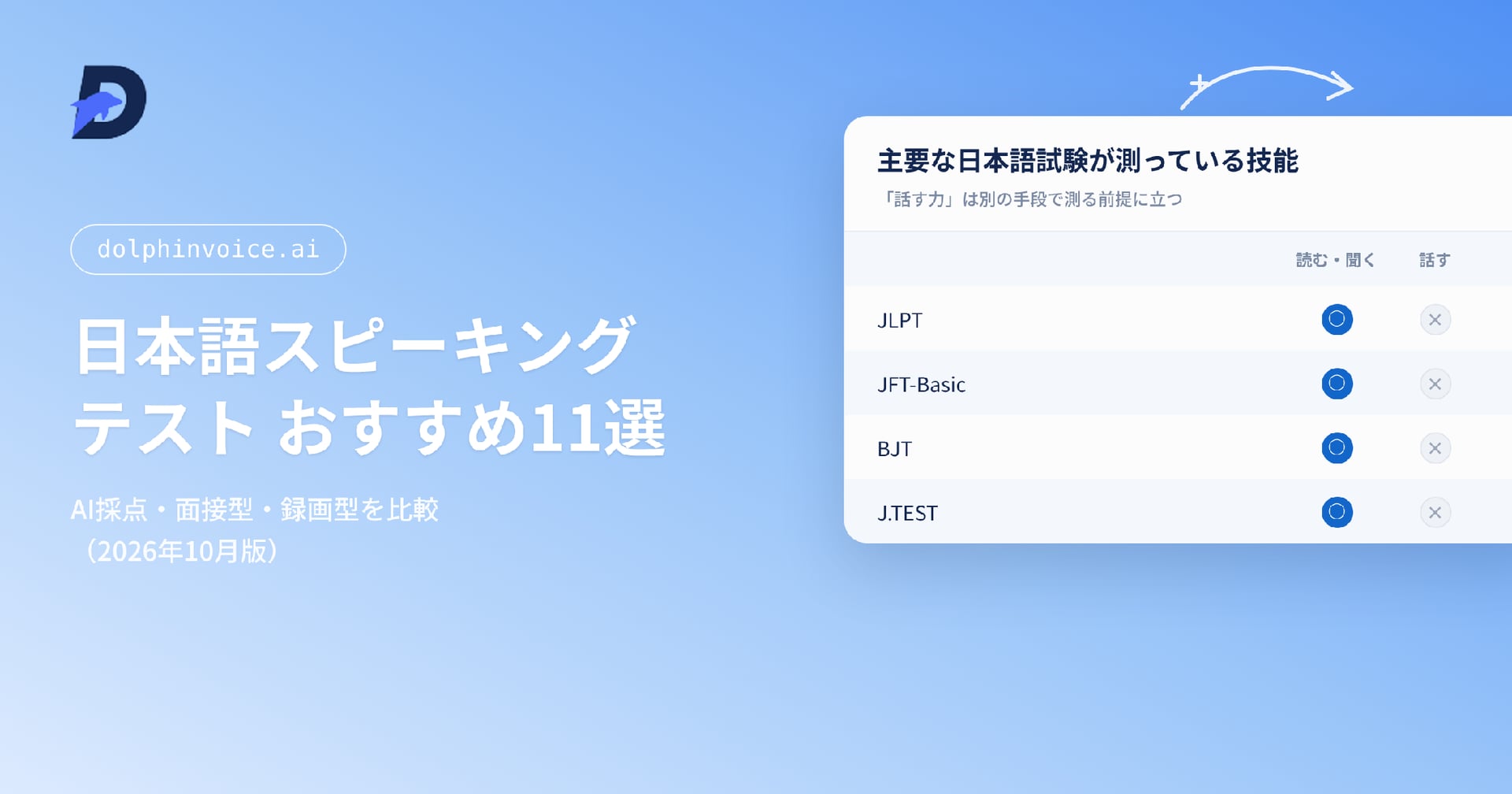
Yet many familiar Japanese tests do not measure speaking. The JLPT's official FAQ states that it currently has neither a conversation test nor a composition test, with no plans to add them. JFT-Basic, J.TEST, BJT, TOPJ and the Japanese NAT-TEST likewise do not directly assess spoken responses. Speaking therefore needs a separate assessment.
 Language skills measured by major Japanese proficiency tests
This article is written by DolphinVoice, the provider of NihongoScore, an AI-scored Japanese speaking test. Because our own product is included, services are grouped by type rather than ranked. We apply the same comparison criteria to NihongoScore and explain where it may not be suitable.
Using information available in October 2026, we compare 11 services that assess spoken Japanese across six dimensions: scoring method, assessment framework, duration, delivery format, price and business administration features.
Why speaking needs its own assessment
Japanese education under the new employment program
The Employment for Skill Development program takes effect on April 1, 2027. The Immigration Services Agency's public materials and Q&A, as reviewed in October 2026, describe the following requirements.
Before starting work, participants must pass a Japanese-language test equivalent to A1 or complete at least 100 hours of an A1-equivalent employment course at an accredited Japanese-language education institution. They do not necessarily need to have passed the test when entering Japan.
 Japanese-language requirements under the Employment for Skill Development program taking effect in April 2027
Post-arrival training requires at least 320 hours for those who have not passed an A1-equivalent test, or 220 hours for those who have. If pre-arrival training was completed within the preceding six months, these periods can be reduced to at least 160 and 110 hours respectively.
During employment, the receiving employer must provide opportunities to complete at least 100 hours of an A2-equivalent employment course, including covering the cost. Those who have already passed the applicable test do not need to take the course.
When moving to Specified Skilled Worker (i), participants must pass the relevant skills test and a Japanese test such as JFT-Basic at A2.2-equivalent level or JLPT N4. Unlike the examination exemption currently available to people who satisfactorily complete Technical Intern Training (ii), passing the tests is required under the new program.
The employer's obligation is to provide learning opportunities; the program does not prescribe an employer's method for measuring speaking improvement. After providing 100 hours of instruction, the employer still needs a way to see whether employees can communicate more effectively. JLPT and JFT-Basic do not test speaking, so demonstrating spoken-language progress requires a separate assessment.
Details may change through ministerial ordinances, operational guidelines and additional requirements for individual sectors. The program's guidelines were published in February 2026 and updated on April 6 and August 5. Consult the Immigration Services Agency's latest materials before implementation.
JFT-Basic now assesses additional levels
From August 2026, JFT-Basic added A1 and A2.1 assessments. Previously, it assessed only A2.2-equivalent proficiency. The official announcement explains that this allows it to assess levels required for the new program as well as Specified Skilled Worker (i).
On October 5, 2026, the Immigration Services Agency also published material encouraging people considering JLPT N4 or N5 to consider JFT-Basic. JLPT is offered twice a year, whereas JFT-Basic is generally held monthly using computer-based testing, which can make scheduling easier.
However, all four JFT-Basic sections—script and vocabulary, conversation and expression, listening comprehension, and reading comprehension—are answered on screen. Candidates do not speak. “Conversation and expression” is a section name, not a speaking assessment.
Hiring, placement and training need different evidence
Hiring calls for consistent criteria that reduce the influence of individual interviewers' impressions or their rapport with a candidate. In businesses hiring across several locations and teams, inconsistent judgments create additional work and cost.
Placement after hiring requires evidence for decisions such as whether an employee can handle customer-facing work or should begin in a back-office role. A graded framework such as CEFR can support these discussions better than a broad pass/fail result.
Training evaluation calls for comparable scores before and after instruction. A test offered only twice a year may not fit a short training cycle. Being able to repeat an assessment using the same criteria matters. Decide which of these three purposes is primary before selecting a service.
Three main testing and assessment formats
Speaking services can be grouped into three broad types based on how candidates respond and how their responses are assessed. Each has different strengths and constraints.
 Three Japanese speaking test formats: AI scoring, human interviews and recorded submissions
Human interviews
A trained tester speaks with the candidate and evaluates the interaction live or from a recording. Examples include ACTFL OPI, JOPT, ALC's JSST and JapaTalk's conversation certification.
The strength is the ability to observe natural interaction and responsiveness, alongside the credibility of established frameworks. ACTFL, for example, supports international, academic and educational uses. The trade-offs are scheduling, limited capacity to scale quickly and potentially higher unit costs. A task such as assessing 100 people in one week requires careful capacity checks.
Recorded submissions
Candidates record answers on a smartphone or another device and submit them for later assessment. S-JEP Speaking and JPET Speaking Test use this format.
Candidates can participate from home or work at a convenient time without booking an interviewer. Some services combine video recordings with a previously submitted photograph for identity verification. However, one-way answers reveal less about spontaneous interaction, and scoring takes time after submission.
AI scoring and hybrid assessment
These services combine Speech Recognition with AI to evaluate Pronunciation, Fluency, vocabulary, grammar and other aspects of speaking. NihongoScore and AISATS use AI scoring. Japrise combines an initial AI evaluation with final confirmation by a human assessor.
Advantages can include immediate or faster results, simultaneous testing for many candidates, repeatable use of the same assessment criteria and lower unit costs. This makes the format worth considering for repeated measurements such as pre- and post-training assessments.
Validity still needs to be checked before adoption. Services differ in how thoroughly agreement between AI scores and expert judgments has been evaluated. We recommend testing employees whose proficiency is already understood and comparing the scores with that knowledge.
Six criteria to compare
Scoring method and testing volume
Start with the number of candidates and the testing frequency. Human interviews may suit a small number of detailed assessments each year. AI scoring may suit tens or hundreds of candidates each month, especially when measuring training outcomes. Hybrid or recorded-submission formats can provide another option when decisions are important and a reasonable volume must be handled.
CEFR and other assessment frameworks
CEFR describes language proficiency across six levels, from A1 to C2. Japan's Framework of Reference for Japanese Language Education corresponds to it, and the new employment program expresses language requirements in A1- and A2-equivalent terms.
A CEFR-aligned speaking test can make internal discussions about proficiency levels easier. Scores on a proprietary ten-level or other scale require a separate explanation of how they relate to those levels. A speaking test still does not replace an officially designated examination.
Since the December 2025 sitting, JLPT score reports have included a CEFR reference level, but it is not used to determine whether a candidate passes.
 CEFR levels, program requirements and methods for assessing speaking ability
Duration and task coverage
Test lengths range from around 15 minutes to 20–40 minutes. Excessive assessment demands can discourage job candidates, but a very short test may not cover enough: reading aloud and short answers alone do not reveal the ability to explain or negotiate.
NihongoScore combines basic tasks such as reading aloud, selection and repetition from memory with interviews, speeches, role-plays and picture-based composition. Consider both the time required and whether the tasks cover your intended use.
Location and scheduling
Check whether candidates must attend a test center, can complete everything online, must use fixed dates or can test on demand. These differences affect administration costs.
In-person tests may be difficult to arrange for overseas candidates. Conversely, test-center or proctored formats can be valuable when preventing misconduct is a priority.
Pricing and quote assumptions
Many speaking services do not publish prices. Public fees are more common among tests aimed at individuals: JLPT costs ¥7,500 in Japan including consumption tax; JFT-Basic costs ¥10,000 including the consumption-tax equivalent; BJT costs ¥6,999 including tax; and the standard public J.TEST fee is ¥5,800. JapaTalk's conversation certification costs ¥3,300 for Grades 3 and 4 and ¥4,400 for Grade 2 and above, including tax. The first four tests do not assess speaking.
The reviewed official pages did not publish fees for JOPT, ACTFL OPI/OPIc, PROGOS Japanese, S-JEP Speaking, JPET Speaking, JSST or Japrise. NihongoScore also uses individual quotes based on candidate numbers, frequency and required administration features.
Give providers the same assumptions about annual candidate numbers, test frequency and features. A per-test price is not comparable without the surrounding terms.
Business administration features
For ongoing assessment of dozens or more candidates, check for:
- Bulk candidate registration and invitations.
- Status tracking for tests not started, in progress and completed.
- Consolidated scores and CSV or similar exports.
- Progress tracking across repeated attempts.
- Reporting by location or department.
BJT supports bulk purchases of examination tickets and group results pages. NihongoScore provides a business dashboard for candidate management, CEFR distributions, pass rates and monthly trends. With tests designed primarily for individuals, employers may need to manage this work in spreadsheets.
Comparison of 11 services
The following reflects official information reviewed in October 2026. Items not publicly specified are marked “Ask provider.” Services are grouped by type; the order is not a ranking.
| Service | Scoring | Framework | Duration | Delivery | Price | Business features |
|---|---|---|---|---|---|---|
| NihongoScore (our product) | AI: Speech Recognition + LLM | CEFR | About 15–20 min | Online, on demand, simultaneous candidates | Individual quote | Dashboard, CEFR distribution, progress tracking |
| AISATS | AI | Ask provider | Ask provider | Ask provider | Ask provider | Ask provider |
| Japrise | AI first pass; expert final decision | CEFR / Framework of Reference for Japanese Language Education | About 20 min | Fully online, on demand | Ask provider | B2B offering |
| JOPT | Human oral interview | Proprietary: academic, business, community, care | Ask provider | In person or online | Ask provider | Ask provider |
| ACTFL OPI | Certified human tester evaluates recordings | ACTFL: Novice–Superior | Ask provider | Phone or in-person interview | Ask provider | Ask provider |
| ACTFL OPIc (Japanese) | ACTFL-certified human Rater | ACTFL: Novice–Superior | Average 20–40 min | Computer, online | Ask provider | Ask provider |
| JSST (ALC) | Specialist human review of recordings | Proprietary ten levels | About 15 min | Phone | Ask provider | Ask provider |
| Japanese Conversation Certification (JapaTalk) | One-to-one human interview | Proprietary five levels | 25 min | Online via Teams, on demand | Grades 3–4: ¥3,300; Grade 2 and above: ¥4,400, tax included | Not specified |
| S-JEP Speaking | Ask provider | Six CEFR-aligned levels, out of 100 | About 15 min | Online, smartphone recording | Ask provider | Intended for hiring and training |
| JPET Speaking Test | Ask provider | CEFR-aligned, out of 100 | About 15 min | Online, smartphone recording | Ask provider | Group applications only |
| PROGOS Japanese | Ask provider | Six CEFR levels: A1–C2 | Ask provider | Online conversation test | Ask provider | Ask provider |
Reference: major tests that do not assess speaking but may serve official requirements
| Test | Speaking | Framework | Fee in Japan | Frequency |
|---|---|---|---|---|
| JLPT | No; confirmed in official FAQ | N1–N5; CEFR is a reference only | ¥7,500 including consumption tax | Twice yearly: July and December |
| JFT-Basic | No | CEFR / Framework of Reference for Japanese Language Education | ¥10,000 including consumption-tax equivalent | Generally monthly, CBT |
| BJT | No | 0–800 points, J5–J1+ | ¥6,999 including tax | Daily, CBT |
| J.TEST | No | Grades A–G | Standard public test: ¥5,800 | A–C / D–E six times yearly |
Service strengths and limitations
NihongoScore (our product)
NihongoScore combines Speech Recognition (ASR) and an LLM to assess spoken Japanese automatically and return scores against the CEFR Standard. Speech Recognition handles Pronunciation and Fluency, while the LLM addresses vocabulary and grammatical range, grammatical accuracy, conversational naturalness and logical organization. The design considers how ideas are constructed as well as how words are pronounced.
Tasks are divided into basic and advanced groups. Basic tasks include reading aloud (eight questions, 3–40 seconds), selection (5 seconds), quizzes (20 seconds) and repetition from memory (10 seconds). Advanced tasks include interviews (five questions, 20 seconds each), a speech (40 seconds to prepare and 60 to respond), a role-play (40 seconds to prepare, then four 30-second responses) and picture-based composition (40 seconds to prepare and 60 to respond). Total duration is about 15–20 minutes.
Score report: strengths, gaps and learning advice
Alongside an overall score and CEFR level, the report uses a radar chart to show six dimensions. The aim is to help candidates understand both what they can already do and what they should work on next.
Diversity
the range of vocabulary and expressions used.
Accuracy
correctness of grammar and expression.
Communication
the ability to respond appropriately to another speaker.
Structure
coherence and logical organization.
Fluency
smoothness and pace of speech.
Pronunciation
pronunciation and other features of spoken delivery.
The report provides more natural expressions and examples suited to workplace situations, allowing candidates to compare them with their own answers. It also offers learning advice. Someone with accuracy gaps might practice conditional expressions or polite directions; someone with organizational difficulties might practice explaining a point through a claim, a reason and a concrete example. Advice can support strengths as well as address weaknesses.
Reports can be downloaded as PDFs for personal review and for setting learning goals with training managers.
 NihongoScore report showing strengths, improvement areas, revised expressions and learning advice
Growth chart: changes across repeated attempts
Understanding training outcomes requires more than one score. NihongoScore's administration interface displays each candidate's scores over time as color-coded lines for the assessment dimensions.
Results can be filtered by subject area, difficulty and period, making it easier to compare attempts under similar conditions. Hovering over a test date shows the scores for that attempt.
The interface also summarizes test attempts, completed assessments, highest and average scores, and the latest result within the selected conditions. These views can support explanations of pre- and post-training changes or individual discussions about the next learning goal.
 NihongoScore growth chart with score trends filtered by subject area, difficulty and period
The business dashboard covers candidate management, CEFR distributions, pass rates and monthly trends. Assessment content can be customized for scenarios such as restaurants and convenience stores, and API integration is available for EdTech providers. Security measures address ISO 27001, SOC 2, SSL (Secure Sockets Layer)/TLS and APPI (Act on the Protection of Personal Information).
Suitable uses include aligning hiring assessments across locations and interviewers, supporting placement decisions, comparing training outcomes using the same criteria, and assessing Japanese for customer-facing situations in convenience stores, restaurants, hotels and care settings.
Limitations and considerations: fees depend on candidate numbers and use case, so an individual quote is required. A publicly priced service may be easier to compare when initially estimating a budget. If company policy requires an ACTFL assessment, ACTFL OPI/OPIc is more suitable. As with any AI-scored service, run sample assessments with people whose proficiency is already understood before adoption.
AISATS (eBrand Lab)
AISATS uses conversations with AI to assess Japanese and English speaking automatically. Its public information states that it is eligible under Japan's 2026 digitalization and AI adoption subsidy program.
Considerations: the reviewed website did not establish assessment items, duration, delivery details or fees. Contact the provider directly.
Japrise (Babel Method)
Japrise combines an initial AI evaluation with a final decision by a specialist human assessor. It states that it fully follows CEFR and corresponds to Japan's Framework of Reference for Japanese Language Education. The test is fully online, available on demand and uses open responses, taking about 20 minutes.
On October 1, 2026, the provider announced full operation of AI evaluation support, reducing turnaround from about ten business days to as little as two. The approach aims to combine the validity of human assessment with AI-assisted speed, making it a candidate for hiring decisions that require both defensible judgments and timely results. A B2B offering is available.
Considerations: fees are not published. The official site could not be accessed during the information review, so confirm current specifications directly.
JOPT (Japanese Oral Proficiency Test)
JOPT was developed through a research-grant project and is operated by a team established in April 2020, with support from the Aclass Institute of Japanese Language Education.
A human tester conducts an oral interview. In-person formats can use a computer alone, a computer with paper materials, or paper alone. Online delivery can use screen-shared illustrations with audio and video recording. AI scoring is not specified.
A distinguishing feature is its four domains: A for academic, B for business, C for community and K for care. Domains can be selected or combined as needed. The care-specific option may suit organizations seeking a research-based framework tied to a particular work setting.
Considerations: level categories, fees, duration, turnaround and business administration features could not be confirmed on the official site. Its domain is jopt-team.org; check carefully when applying because similar domains can be unrelated.
ACTFL OPI
ACTFL OPI is an oral proficiency interview based on standards from the American Council on the Teaching of Foreign Languages and is available in Japanese. A certified tester interviews candidates by phone or in person, then uses the recording to determine a level from Novice Low to Superior. Related organizations in Japan include iJapan, while the Japan OPI research association operates as a tester organization.
Its strength is the international applicability of its framework, supporting assessments within global companies and explanations of proficiency in academic settings. It is also included in the Agency for Cultural Affairs' list of Japanese-language assessments and examinations.
Considerations: fees and turnaround are not stated on the reviewed official pages. Contact the administering organization. Tester scheduling is necessary, so confirm capacity for large groups within short periods.
ACTFL OPIc (Japanese)
OPIc delivers the OPI process on a computer. Candidates are assigned one of Forms 1–5 based on their self-assessment, with an average duration of 20–40 minutes. An ACTFL-certified human Rater evaluates responses. The Japanese version is administered by Global8 under license from LTI.
Compared with OPI, scheduling is less demanding, and candidates can participate using a computer. It offers a way to retain ACTFL criteria while accommodating a reasonable number of candidates.
Considerations: fees and turnaround could not be confirmed on the reviewed official pages. Human scoring means results are not immediate.
JSST (ALC)
ALC's Japanese conversation test is conducted by phone. A conversation of about 15 minutes is recorded and assessed by specialist evaluators using a proprietary ten-level scale. The Agency for Cultural Affairs' listing says multiple evaluators review the recording.
Its practical advantage is completing the process by phone without preparing a computer or app. This can be useful for candidates in places with unreliable internet access.
Considerations: standard fees could not be confirmed on the official site. Its ten-level scale requires separate interpretation when relating scores to CEFR or official requirements.
Japanese Conversation Certification (JapaTalk)
JapaTalk, an online Japanese lesson provider, offers a 25-minute, one-to-one interview with an examiner through Microsoft Teams. Results use five categories: Expert and Grades 1–4. Candidates can apply on demand, with certification in about a week from application.
This is one of the few speaking assessments with public fees: ¥3,300 for Grades 3 and 4, or ¥4,400 for Grade 2 and above, including tax. It is available only to paid JapaTalk members.
Considerations: bulk business testing and administration features are not described; the site mentions using grades as a reference in recruitment. The relationship between its five categories and CEFR requires separate confirmation.
S-JEP Speaking (Surugadai Gakuen)
This recorded-submission test is offered by Surugadai Gakuen's Japanese-language assessment association. It consists of eight questions across four areas: pronunciation, responses, conversation and presentation. Candidates record and submit answers on a smartphone in about 15 minutes.
Scores are out of 100 and correspond to six CEFR-aligned levels: C2 at 93–100, C1 at 76–92, B2 at 60–75, B1 at 43–59, A2 at 26–42 and A1 at 10–25. Published score bands can help employers define internal criteria. Identity checks combine camera recordings with a photograph submitted beforehand.
Candidates can test from home or work. Intended uses include hiring, training and employee evaluation, as well as school admissions and class placement.
Considerations: the official site did not establish the fee or whether scoring is performed by AI or humans.
JPET Speaking Test (Surugadai Gakuen)
Also offered by Surugadai Gakuen, this test entered regular sales in April 2025 and launched in May. Like S-JEP Speaking, it is CEFR-aligned, scored out of 100, takes about 15 minutes and uses smartphone video submissions.
Applications are currently accepted only through groups, making it a service for coordinated testing by businesses and educational institutions. The main written JPET does not assess speaking, so specify JPET Speaking Test when applying.
Considerations: fees, scoring method and turnaround could not be confirmed on the official site.
PROGOS Japanese (RareJob Group)
RareJob Group, known for the English speaking test PROGOS, offers a Japanese version developed through joint research with Tokyo University of Foreign Studies. Official materials describe an online conversation test using six CEFR levels from A1 to C2.
The English version is used to evaluate business training outcomes. Organizations already using PROGOS may find that experience helpful when considering a Japanese assessment.
Considerations: the Japanese version's scoring method, task structure, duration, price, turnaround and business administration features could not be confirmed on the reviewed official site. The English version uses AI scoring, but this does not establish that the Japanese version uses the same method. Ask the provider.
Integrating a Pronunciation Assessment API
Businesses developing their own Japanese learning app, LMS or training system can integrate an assessment API instead of purchasing a complete test service.
DolphinVoice's Japanese Pronunciation Assessment API returns assessments for words, phrases and sentences. It can provide feedback after each pronunciation exercise or power short quizzes within a training system. An online English word-assessment demo shows example results.
The dividing line is development capacity. Choose a ready-made test if you do not have a development team; consider an API if you want assessment inside your own product.
Choosing by use case
Hiring
prioritize validity and an explainable basis for decisions. Options include AI-scored services such as NihongoScore, Japrise's hybrid approach, or ACTFL OPIc where an international framework is important. For overseas candidates, focus on fully online delivery. Around 20 minutes can serve as a practical screening guideline to limit candidate burden.
Placement after hiring
choose a graded framework such as CEFR. Employers must define their own requirements, such as whether customer-facing work calls for B1 or B2. Published score bands, as offered by S-JEP Speaking, or direct CEFR results can make those discussions easier.
Training outcomes
prioritize repeated measurement under the same criteria. Booking human interviews for every round can add administrative work; on-demand AI or recorded-submission services may be easier to operate. This also applies when evaluating the effects of the 100 hours of instruction associated with the new employment program.
Class placement in language or vocational schools
look for short tests that many students can take simultaneously, with fast results. Progress tracking can help if testing is repeated each term.
An existing learning app or training system
consider a Pronunciation Assessment API if you have development capacity.
Official examination requirements
Evidence for official requirements: use the examinations designated by the relevant program, such as JFT-Basic or JLPT. The speaking assessments in this article are internal tools for understanding and developing spoken ability, not substitutes for those requirements. Make the distinction clear internally.
Five checks before adoption
- Validate with sample candidates. Ask several employees whose proficiency is already known, covering a range of levels, to take the test. Compare the results with your understanding of their ability. This is particularly important with AI scoring.
- Request quotes using the same volume assumptions. Specify annual candidate numbers and test frequency. Ask about setup charges and minimum commitments as well as per-test fees.
- Confirm result turnaround. Hiring teams need to know whether results fit the selection schedule. Human assessment can take several days to about two weeks; AI-scored services can range from immediate results to several days. Confirm the provider's actual terms.
- See the administration features in a demo. Check bulk registration, test-status tracking, consolidated score exports and progress history. Weak administration tools can create substantial spreadsheet work once candidate numbers grow beyond a few dozen.
- Check personal-data handling. Voice recordings can contain personal information. Review storage location, retention, use for model training and deletion procedures against internal rules. Recruitment also needs a suitable process for explaining data use and obtaining necessary consent.
Frequently asked questions
Does JLPT N4 prove someone can speak Japanese?
No. JLPT does not assess speaking, and its official FAQ confirms there is no conversation or composition test. N4 indicates relevant reading and listening proficiency; spoken ability needs a separate assessment.
Does the new employment program require speaking tests?
Based on materials available in October 2026, employers must provide opportunities for at least 100 hours of an A2-equivalent employment course, including the cost. This does not itself mandate a speaking test. To understand spoken-language gains, however, employers need another measure because JLPT and JFT-Basic do not test speaking. Consult the Immigration Services Agency's latest materials as detailed requirements may change.
Is AI or human scoring more reliable?
Neither is universally better. Humans can observe responsiveness during interaction, but judgments may vary between assessors. AI supports repeated use of the same criteria, while its validity still needs checking. For consequential decisions, initial AI assessment followed by human review is another option. DolphinVoice provides AI scoring, but the appropriate method depends on the use case.
Why do so many services require a quote?
Business services commonly price by candidate volume and contract conditions. NihongoScore likewise quotes according to numbers, frequency and administration features. Use the same expected candidate count and annual testing frequency when requesting competing quotes.
Can candidates outside Japan take these tests?
Fully online services allow remote participation. NihongoScore, Japrise, S-JEP Speaking, JPET Speaking, ACTFL OPIc and JapaTalk's certification support online delivery. Check connectivity, time zones and identity verification in advance.
What is the best first step?
Choose one primary purpose: hiring, placement or training evaluation. Shortlist two or three services of an appropriate type, then request quotes and sample assessments using the same conditions.
Match the assessment to the purpose
Start with your candidate numbers, testing frequency and intended decision. Familiar Japanese examinations may not test speaking. CEFR helps explain proficiency levels, but internal speaking assessments and officially designated examinations serve different roles. Request comparable quotes and validate AI results with sample candidates before adopting a service.
If you need on-demand online testing, fast scores against the CEFR Standard and ongoing candidate progress tracking, consider NihongoScore. It combines Speech Recognition and an LLM to evaluate Pronunciation, Fluency, vocabulary and grammar, conversational naturalness and logical organization. Industry scenarios can be customized for restaurants, convenience stores and similar settings, while the business dashboard tracks proficiency distributions and monthly trends.
If your policies require ACTFL results or you want a person to observe live interaction, consider the corresponding human assessment. Teams developing a Japanese learning app or LMS can instead consider a Pronunciation Assessment API.
Explore NihongoScore
Review the Japanese speaking assessment and business administration features for hiring and training.
Explore the Japanese Pronunciation Assessment API
Add pronunciation feedback to your learning app, LMS or training system.
Request a demo or consultation
Share your candidate numbers, testing frequency and use case to discuss an appropriate test or API setup.
The Employment for Skill Development program takes effect in April 2027. Defining measurement methods, aligning internal criteria and becoming familiar with delivery in advance can help employers explain both course design and outcomes with evidence.
Information in this article reflects October 2026 and is based on service websites and public materials from the Immigration Services Agency, Ministry of Health, Labour and Welfare, Agency for Cultural Affairs and related bodies. Fees, test content and operational rules may change. For Employment for Skill Development and Specified Skilled Worker requirements, consult the Immigration Services Agency's latest public materials.